


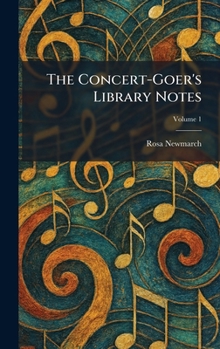
The Concert-Goer's Library Notes

"The Concert-Goer's Library Notes" (Volume 1) is an essential companion for lovers of classical music, providing insightful and authoritative analysis of the orchestral repertoire. Written by the renowned musicologist Rosa Newmarch, this volume draws upon her celebrated program notes created for the Queen's Hall concerts in London. It offers readers a detailed look into the structural nuances, historical contexts, and artistic significance of major symphonic works.
In this first volume, Newmarch focuses on the evolution of the symphony, guiding the reader through the masterpieces of composers such as Beethoven, Brahms, Haydn, and Mozart. Her writing style is both accessible and scholarly, bridging the gap between the technicalities of music theory and the emotional experience of the listener. Whether used as a reference for concert preparation or as a study of musical history, this work remains a vital resource for understanding the foundations of the Western classical tradition. Newmarch's pioneering contributions to music criticism shine through in her ability to illuminate the complexities of the score while fostering a deeper appreciation for the art form.
This work has been selected by scholars as being culturally important, and is part of the knowledge base of civilization as we know it. This work was reproduced from the original artifact, and remains as true to the original work as possible. Therefore, you may see the original copyright references, library stamps (as most of these works have been housed in our most important libraries around the world), and other notations in the work.
This work is in the public domain in the United States of America, and possibly other nations. Within the United States, you may freely copy and distribute this work, as no entity (individual or corporate) has a copyright on the body of the work.
As a reproduction of a historical artifact, this work may contain missing or blurred pages, poor pictures, errant marks, etc. Scholars believe, and we concur, that this work is important enough to be preserved, reproduced, and made generally available to the public. We appreciate your support of the preservation process, and thank you for being an important part of keeping this knowledge alive and relevant.
Customer Reviews
ThriftBooks ® and the ThriftBooks ® logo are registered trademarks of Thrift Books Global, LLC
