


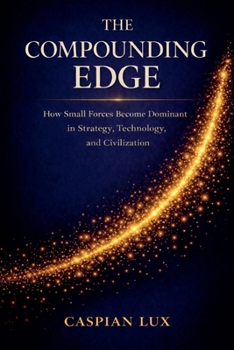
The Compounding Edge: How Small Forces Become Dominant in Strategy, Technology, and Civilization Series Strategic Advantage Series

Strategic outcomes are rarely determined by size alone. They are shaped by how forces grow over time.
The Compounding Edge examines what happens when two processes compete while growing at different rates. One may begin larger, more visible, and apparently dominant. The other may appear small, experimental, or easy to dismiss. Yet when the smaller process compounds faster, the relationship eventually reverses.
This pattern appears repeatedly across modern economic and technological history. Small platforms become global infrastructures. Emerging technologies displace established industries. New knowledge systems reorganize entire markets. In each case the signals were present early, but the implications of compounding change were difficult to interpret.
Caspian Lux explores why these reversals occur and why they are so often misread while they are unfolding. Drawing on ideas from mathematics, economics, cognitive science, and systems thinking, the book explains how small differences in growth rates accumulate into decisive advantages.
The Compounding Edge introduces a practical framework for recognizing compounding dynamics inside competitive environments. It shows how reinforcing feedback loops develop, how structural advantages build gradually, and why accelerating systems are consistently underestimated by experienced decision-makers.
For strategists, analysts, founders, investors, and readers interested in long-term change, the book offers a clear way to think about forces that quietly reshape industries and institutions.
The most important strategic moment rarely occurs when dominance becomes visible.
It occurs much earlier - during the long period when the faster force still appears to be losing.
Customer Reviews
ThriftBooks ® and the ThriftBooks ® logo are registered trademarks of Thrift Books Global, LLC
