


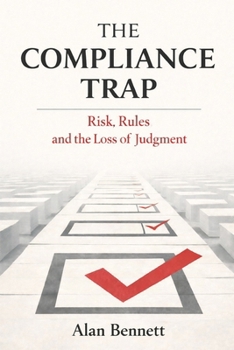
The Compliance Trap: Risk, Rules and the Loss of Judgment
No Customer Reviews

What happens when systems created to ensure responsibility begin to replace human judgment itself?
Across modern societies, regulation, risk management, and compliance frameworks have become central organising features of professional and institutional life. They promise consistency, accountability, transparency, and protection against error. In many respects, they have succeeded. Standards have improved, oversight has strengthened, and public trust has been reinforced.
Yet beneath these achievements, a quieter institutional transformation has unfolded.
In The Compliance Trap: Risk, Rules and the Loss of Judgment, Alan Bennett examines how expanding rule systems increasingly shape not only how organisations operate, but how professionals think, decide, and assume responsibility. Drawing upon decades of experience in international legal practice, regulatory advisory work, and academic research, Bennett explores how compliance evolved from a supportive safeguard into a dominant framework governing modern decision-making.
As intolerance of risk grows and retrospective scrutiny intensifies, institutions naturally seek protection through procedures, documentation, metrics, and audit trails. Decisions are increasingly structured to withstand review rather than to exercise informed discretion. Responsibility becomes dispersed across systems rather than carried by identifiable decision makers.
The consequence is rarely visible failure. Instead, organisations become formally compliant yet operationally fragile.
Professionals remain accountable while their authority narrows. Innovation slows as defensibility replaces experimentation. Ethical reasoning becomes procedural alignment. Judgment is not abolished, but progressively reformatted.
Through clear analysis supported by practical illustrations drawn from law, medicine, finance, engineering, education, public administration, and corporate governance, this book traces:
- the historical role of judgment as the foundation of professional trust
- the rise of risk management as an organising epistemology
- the emergence of compliance culture as institutional self-protection
- the psychological and ethical effects of continuous audit environments
- the redistribution of responsibility within complex organisations
- the growing tension between human expertise and automated oversight
- the implications of artificial intelligence and algorithmic governance for future professional autonomy
Importantly, The Compliance Trap does not advocate deregulation or diminished accountability. Oversight remains essential in complex societies. The challenge addressed here is structural rather than ideological: how institutions can preserve legitimacy and safety without eliminating the human discretion upon which responsible action ultimately depends.
Combining legal insight, institutional analysis, and philosophical reflection, Bennett offers a timely examination of one of the defining governance dilemmas of the twenty-first century. The book speaks directly to professionals navigating increasingly dense regulatory environments and to leaders seeking sustainable models of accountability in an era of accelerating complexity.
This work will resonate with:
- lawyers, regulators, and compliance professionals
- directors, executives, and governance leaders
- policy makers and public administrators
- academics and students of law, management, ethics, and public policy
- professionals confronting expanding procedural oversight in their daily work
At a moment when organisations face regulatory expansion, technological surveillance, and rising expectations of institutional perfection, The Compliance Trap asks an urgent question:
Can modern institutions remain accountable without losing the human judgment that makes responsibility meaningful?
Across modern societies, regulation, risk management, and compliance frameworks have become central organising features of professional and institutional life. They promise consistency, accountability, transparency, and protection against error. In many respects, they have succeeded. Standards have improved, oversight has strengthened, and public trust has been reinforced.
Yet beneath these achievements, a quieter institutional transformation has unfolded.
In The Compliance Trap: Risk, Rules and the Loss of Judgment, Alan Bennett examines how expanding rule systems increasingly shape not only how organisations operate, but how professionals think, decide, and assume responsibility. Drawing upon decades of experience in international legal practice, regulatory advisory work, and academic research, Bennett explores how compliance evolved from a supportive safeguard into a dominant framework governing modern decision-making.
As intolerance of risk grows and retrospective scrutiny intensifies, institutions naturally seek protection through procedures, documentation, metrics, and audit trails. Decisions are increasingly structured to withstand review rather than to exercise informed discretion. Responsibility becomes dispersed across systems rather than carried by identifiable decision makers.
The consequence is rarely visible failure. Instead, organisations become formally compliant yet operationally fragile.
Professionals remain accountable while their authority narrows. Innovation slows as defensibility replaces experimentation. Ethical reasoning becomes procedural alignment. Judgment is not abolished, but progressively reformatted.
Through clear analysis supported by practical illustrations drawn from law, medicine, finance, engineering, education, public administration, and corporate governance, this book traces:
- the historical role of judgment as the foundation of professional trust
- the rise of risk management as an organising epistemology
- the emergence of compliance culture as institutional self-protection
- the psychological and ethical effects of continuous audit environments
- the redistribution of responsibility within complex organisations
- the growing tension between human expertise and automated oversight
- the implications of artificial intelligence and algorithmic governance for future professional autonomy
Importantly, The Compliance Trap does not advocate deregulation or diminished accountability. Oversight remains essential in complex societies. The challenge addressed here is structural rather than ideological: how institutions can preserve legitimacy and safety without eliminating the human discretion upon which responsible action ultimately depends.
Combining legal insight, institutional analysis, and philosophical reflection, Bennett offers a timely examination of one of the defining governance dilemmas of the twenty-first century. The book speaks directly to professionals navigating increasingly dense regulatory environments and to leaders seeking sustainable models of accountability in an era of accelerating complexity.
This work will resonate with:
- lawyers, regulators, and compliance professionals
- directors, executives, and governance leaders
- policy makers and public administrators
- academics and students of law, management, ethics, and public policy
- professionals confronting expanding procedural oversight in their daily work
At a moment when organisations face regulatory expansion, technological surveillance, and rising expectations of institutional perfection, The Compliance Trap asks an urgent question:
Can modern institutions remain accountable without losing the human judgment that makes responsibility meaningful?
Format:Paperback
Language:English
ISBN:B0GR6FBWKP
ISBN13:9798250687010
Release Date:March 2026
Publisher:Independently Published
Length:256 Pages
Weight:0.76 lbs.
Dimensions:0.5" x 6.0" x 9.0"
Customer Reviews
0 rating
Copyright © 2026 Thriftbooks.com Terms of Use
| Privacy Policy | Do Not
Sell/Share My Personal Information | Cookie Policy | Cookie Preferences | Accessibility Statement
ThriftBooks® and the ThriftBooks® logo are registered trademarks of Thrift Books Global, LLC
ThriftBooks® and the ThriftBooks® logo are registered trademarks of Thrift Books Global, LLC
