


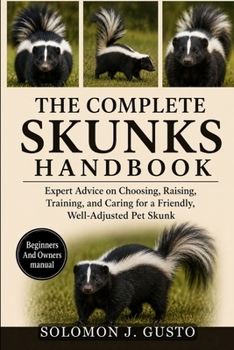
The Complete Skunks Handbook: A Practical Guide to Understanding, Caring for, and Living with Pet Skunks
No Customer Reviews

Introduction to Skunks
What Is a Skunk?
Skunks are medium-sized mammals best known for their remarkable defense mechanism: the ability to spray a strong-smelling liquid from specialized scent glands located near the base of their tail. They belong to the family Mephitidae, a group that includes several skunk species and stink badgers. Although they are often mistaken for members of the weasel family, skunks are classified in their own distinct family due to their unique anatomy and evolutionary history.
Native primarily to North and Central America, skunks occupy a wide variety of habitats, including forests, grasslands, deserts, wetlands, and even suburban neighborhoods. Their adaptability has allowed them to thrive in environments where food and shelter are readily available.
Skunks are omnivores, meaning they consume both plant and animal matter. Their diet includes insects, worms, small rodents, eggs, fruits, berries, nuts, seeds, and occasionally human food scraps. This varied diet helps them play an important ecological role by controlling insect and rodent populations.
Despite their fearsome reputation, skunks are generally gentle, curious, and non-aggressive animals. They prefer to avoid conflict and will only use their famous spray as a last resort after displaying warning behaviors such as stomping their feet, raising their tail, hissing, or turning their back toward a perceived threat.
Wild vs. Domestic Skunks
Although they belong to the same species, wild and domestically raised skunks differ significantly in behavior, lifestyle, and their relationship with humans.
Wild Skunks
Wild skunks spend their lives searching for food, avoiding predators, and raising their young in natural habitats. They are mostly nocturnal, becoming active after sunset to forage for insects, fruits, and small animals.
Wild skunks:
Retain their scent glands for self-defense.
Avoid humans whenever possible.
Build dens under logs, brush piles, rock crevices, or abandoned burrows.
Survive independently without human care.
Can carry diseases such as rabies in some regions.
Because they are wild animals, they should never be captured or kept as pets.
Domestic Skunks
Domestic skunks are typically captive-bred animals raised by licensed breeders in places where ownership is legal. In many countries and states, pet skunks have their scent glands surgically removed by a veterinarian at a young age, although this practice is controversial and prohibited in some regions.
What Is a Skunk?
Skunks are medium-sized mammals best known for their remarkable defense mechanism: the ability to spray a strong-smelling liquid from specialized scent glands located near the base of their tail. They belong to the family Mephitidae, a group that includes several skunk species and stink badgers. Although they are often mistaken for members of the weasel family, skunks are classified in their own distinct family due to their unique anatomy and evolutionary history.
Native primarily to North and Central America, skunks occupy a wide variety of habitats, including forests, grasslands, deserts, wetlands, and even suburban neighborhoods. Their adaptability has allowed them to thrive in environments where food and shelter are readily available.
Skunks are omnivores, meaning they consume both plant and animal matter. Their diet includes insects, worms, small rodents, eggs, fruits, berries, nuts, seeds, and occasionally human food scraps. This varied diet helps them play an important ecological role by controlling insect and rodent populations.
Despite their fearsome reputation, skunks are generally gentle, curious, and non-aggressive animals. They prefer to avoid conflict and will only use their famous spray as a last resort after displaying warning behaviors such as stomping their feet, raising their tail, hissing, or turning their back toward a perceived threat.
Wild vs. Domestic Skunks
Although they belong to the same species, wild and domestically raised skunks differ significantly in behavior, lifestyle, and their relationship with humans.
Wild Skunks
Wild skunks spend their lives searching for food, avoiding predators, and raising their young in natural habitats. They are mostly nocturnal, becoming active after sunset to forage for insects, fruits, and small animals.
Wild skunks:
Retain their scent glands for self-defense.
Avoid humans whenever possible.
Build dens under logs, brush piles, rock crevices, or abandoned burrows.
Survive independently without human care.
Can carry diseases such as rabies in some regions.
Because they are wild animals, they should never be captured or kept as pets.
Domestic Skunks
Domestic skunks are typically captive-bred animals raised by licensed breeders in places where ownership is legal. In many countries and states, pet skunks have their scent glands surgically removed by a veterinarian at a young age, although this practice is controversial and prohibited in some regions.
Format:Paperback
Language:English
ISBN:B0HK217CCR
ISBN13:9798173434227
Release Date:September 2026
Publisher:Independently Published
Length:244 Pages
Weight:0.73 lbs.
Dimensions:0.5" x 6.0" x 9.0"
Customer Reviews
0 rating
Copyright © 2026 Thriftbooks.com
Terms of Use | Privacy Policy | Do Not Sell/Share My Personal Information | Cookie Notice | Cookie Preferences | Accessibility Statement
ThriftBooks ® and the ThriftBooks ® logo are registered trademarks of Thrift Books Global, LLC
ThriftBooks ® and the ThriftBooks ® logo are registered trademarks of Thrift Books Global, LLC
