


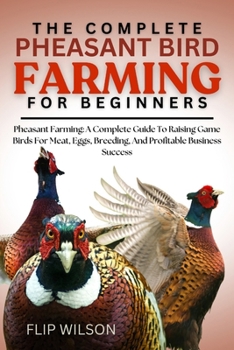
The Complete Pheasant Bird Farming for Beginners: Pheasant Farming: A Complete Guide To Raising Game Birds For Meat, Eggs, Breeding, And Profitable Bu
No Customer Reviews

History and Global Importance of Pheasant Farming
Pheasants have captivated humans for centuries with their striking beauty, elusive nature, and delicious meat. The domestication and farming of pheasants can be traced back thousands of years, particularly in Asia where they were originally native. Historical records suggest that pheasants were being kept in ancient China as early as 2,000 years ago. From Asia, they spread across Europe via trade and conquest, eventually reaching Britain where they were bred for hunting purposes by aristocrats and nobility.
The common Ring-necked Pheasant (Phasianus colchicus), now one of the most widely farmed species, was introduced into the United States in the late 1800s. It quickly became a staple in gamebird hunting, especially in the Midwest. Due to their resilience, adaptability to a wide range of climates, and breeding success in captivity, pheasants have become a prominent species for both recreational hunting and meat production across the globe.
Today, pheasant farming plays a critical role in various sectors including:
1. Gamebird industry: Supplying birds to shooting estates and hunting preserves.
2. Meat production: Providing a lean, flavorful alternative to chicken and turkey.
3. Conservation and rewilding: Breeding programs support repopulation and genetic diversity.
4. Ornamental trade: Colorful species are raised for zoos, aviaries, and bird collectors.
In regions like the United States, the United Kingdom, France, and parts of Asia, pheasant farming has grown into a multi-million-dollar industry. Its value extends beyond economics; it supports local employment, contributes to ecological restoration projects, and adds cultural and recreational richness to rural life.
In countries like the UK, pheasant shooting is tightly intertwined with rural traditions and has shaped land use and conservation strategies. In the U.S., states like South Dakota celebrate the pheasant as a state bird, highlighting its iconic status. As global interest in sustainable, free-range, and alternative meat sources grows, the demand for farm-raised pheasants continues to rise.
Pheasants have captivated humans for centuries with their striking beauty, elusive nature, and delicious meat. The domestication and farming of pheasants can be traced back thousands of years, particularly in Asia where they were originally native. Historical records suggest that pheasants were being kept in ancient China as early as 2,000 years ago. From Asia, they spread across Europe via trade and conquest, eventually reaching Britain where they were bred for hunting purposes by aristocrats and nobility.
The common Ring-necked Pheasant (Phasianus colchicus), now one of the most widely farmed species, was introduced into the United States in the late 1800s. It quickly became a staple in gamebird hunting, especially in the Midwest. Due to their resilience, adaptability to a wide range of climates, and breeding success in captivity, pheasants have become a prominent species for both recreational hunting and meat production across the globe.
Today, pheasant farming plays a critical role in various sectors including:
1. Gamebird industry: Supplying birds to shooting estates and hunting preserves.
2. Meat production: Providing a lean, flavorful alternative to chicken and turkey.
3. Conservation and rewilding: Breeding programs support repopulation and genetic diversity.
4. Ornamental trade: Colorful species are raised for zoos, aviaries, and bird collectors.
In regions like the United States, the United Kingdom, France, and parts of Asia, pheasant farming has grown into a multi-million-dollar industry. Its value extends beyond economics; it supports local employment, contributes to ecological restoration projects, and adds cultural and recreational richness to rural life.
In countries like the UK, pheasant shooting is tightly intertwined with rural traditions and has shaped land use and conservation strategies. In the U.S., states like South Dakota celebrate the pheasant as a state bird, highlighting its iconic status. As global interest in sustainable, free-range, and alternative meat sources grows, the demand for farm-raised pheasants continues to rise.
Format:Paperback
Language:English
ISBN:B0FN3WZXTD
ISBN13:9798298596473
Release Date:August 2025
Publisher:Independently Published
Length:160 Pages
Weight:0.49 lbs.
Dimensions:0.3" x 6.0" x 9.0"
Customer Reviews
0 rating
Copyright © 2026 Thriftbooks.com Terms of Use
| Privacy Policy | Do Not
Sell/Share My Personal Information | Cookie Policy | Cookie Preferences | Accessibility Statement
ThriftBooks® and the ThriftBooks® logo are registered trademarks of Thrift Books Global, LLC
ThriftBooks® and the ThriftBooks® logo are registered trademarks of Thrift Books Global, LLC
