


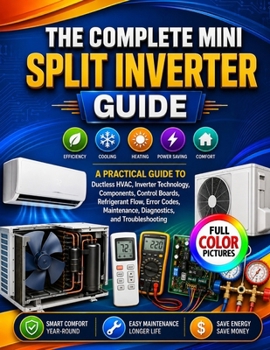
The Complete Mini Split Inverter Guide: A Practical Guide to Ductless HVAC, Inverter Technology, Components, Control Boards, Refrigerant Flow, Error C

Mini-split systems are efficient and versatile-but their inverter electronics, sensors, control boards, refrigerant circuits, and error codes can make troubleshooting feel complicated.
A conventional air conditioner may switch fully on and off, while an inverter mini-split continually adjusts its operation. That difference affects how technicians and informed owners must approach temperatures, airflow, electrical measurements, refrigerant behavior, and fault diagnosis.
The Complete Mini-Split Inverter Guide provides a practical explanation of ductless heating and cooling systems for homeowners, apprentices, maintenance personnel, and developing HVAC technicians.
Inside, you will learn how to:
- Understand how ductless mini-splits work, including single-zone, multi-zone, cooling-only, and heat-pump configurations.
- Compare inverter-driven and fixed-speed systems and understand variable compressor and fan operation.
- Identify major indoor-unit components, including evaporator coils, blowers, filters, louvers, thermistors, control boards, and condensate systems.
- Identify outdoor-unit components, including compressors, condensers, electronic expansion valves, reversing valves, sensors, fans, and inverter modules.
- Follow refrigerant flow during cooling, heating, defrost, and changing-load conditions.
- Understand electrical and communication circuits without treating every control-board failure as a simple parts-replacement problem.
- Interpret error codes logically while recognizing that definitions and test procedures vary by manufacturer and model.
- Diagnose insufficient cooling or heating, icing, water leakage, airflow problems, unusual noises, communication faults, and intermittent shutdowns.
- Use a structured diagnostic sequence involving visual inspection, operating history, airflow checks, temperature measurements, electrical testing, and manufacturer specifications.
- Maintain filters, coils, blowers, outdoor units, drain pans, and condensate lines to support dependable operation.
- Recognize installation-related problems involving sizing, line sets, drainage, electrical supply, mounting, clearances, and refrigerant practices.
- Determine when a problem is suitable for routine maintenance and when it requires a licensed HVAC professional.
Stop replacing parts based only on symptoms. Learn how the components interact, follow a logical troubleshooting process, and approach inverter mini-split systems with greater confidence.
Whether you are maintaining your own system, beginning an HVAC career, or expanding your diagnostic knowledge, this guide provides a practical foundation for understanding modern ductless technology.
Customer Reviews
ThriftBooks ® and the ThriftBooks ® logo are registered trademarks of Thrift Books Global, LLC
