


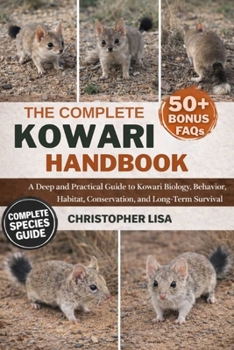
The Complete Kowari Handbook: A Deep and Practical Guide to Kowari Biology, Behavior, Habitat, Conservation, and Long-Term Survival
No Customer Reviews

Introduction to the Kowari
The kowari is one of Australia's least familiar mammals, yet it is among the most remarkable. Small, swift, and perfectly adapted to one of the harshest landscapes on Earth, the kowari embodies the quiet ingenuity of marsupial evolution. To encounter this animal is not to meet a creature of forests or rivers, but a specialist of stone and sand, shaped by heat, scarcity, and long isolation. Its discovery, its place in scientific classification, and the traits that make it unique reveal a story not only of a species, but of an entire continent's evolutionary history.
The kowari belongs to a group of marsupials that developed in almost complete separation from the rest of the world. While placental mammals diversified across Asia, Africa, Europe, and the Americas, Australia became a laboratory of alternative solutions. In this laboratory, small carnivorous marsupials filled roles elsewhere occupied by cats, weasels, and shrews. The kowari is one of the finest surviving examples of this ancient experiment.
Discovery in the Arid Interior
The scientific discovery of the kowari occurred relatively late, not because the animal was newly evolved, but because it lived in places rarely visited by early naturalists. The central deserts and stony plains of Australia were among the last regions explored in detail by European science. Travel was difficult, water scarce, and settlements sparse. Many small nocturnal animals remained unknown for decades after larger and more conspicuous species had been described.
When the kowari was first recorded by Western science in the nineteenth century, it was immediately recognized as unusual. Its long, bushy tail with a darkened tip, its slender body, and its sharp carnivorous teeth distinguished it from the more familiar bandicoots and possums. Early specimens often came from traps set in remote gibber plains and dry creek systems, places where few people had reason to linger.
At the same time, Indigenous Australians had long known the animal. In different regions, it had its own names and its own place in local ecological knowledge. Traditional observation recognized it as a swift night hunter, associated with rocky country and small prey. This earlier knowledge reminds us that "discovery" is often a matter of perspective. Science may have named the kowari late, but the animal itself had been part of the landscape for tens of thousands of years.
Scientific Classification and Its Meaning
In scientific terms, the kowari belongs to the order Dasyuromorphia, a group of carnivorous marsupials that includes quolls, dunnarts, and the Tasmanian devil. Within this order, it is placed in the genus Dasyuroides, a small and highly specialized lineage.
This classification tells an important story. The kowari is not closely related to rodents, despite its size and shape. It is a marsupial predator, descended from ancestors that split from placental carnivores very early in mammalian evolution. Its closest relatives are other Australian dasyurids, animals that evolved to hunt insects, reptiles, and small mammals in environments ranging from rainforest to desert.
The kowari is one of Australia's least familiar mammals, yet it is among the most remarkable. Small, swift, and perfectly adapted to one of the harshest landscapes on Earth, the kowari embodies the quiet ingenuity of marsupial evolution. To encounter this animal is not to meet a creature of forests or rivers, but a specialist of stone and sand, shaped by heat, scarcity, and long isolation. Its discovery, its place in scientific classification, and the traits that make it unique reveal a story not only of a species, but of an entire continent's evolutionary history.
The kowari belongs to a group of marsupials that developed in almost complete separation from the rest of the world. While placental mammals diversified across Asia, Africa, Europe, and the Americas, Australia became a laboratory of alternative solutions. In this laboratory, small carnivorous marsupials filled roles elsewhere occupied by cats, weasels, and shrews. The kowari is one of the finest surviving examples of this ancient experiment.
Discovery in the Arid Interior
The scientific discovery of the kowari occurred relatively late, not because the animal was newly evolved, but because it lived in places rarely visited by early naturalists. The central deserts and stony plains of Australia were among the last regions explored in detail by European science. Travel was difficult, water scarce, and settlements sparse. Many small nocturnal animals remained unknown for decades after larger and more conspicuous species had been described.
When the kowari was first recorded by Western science in the nineteenth century, it was immediately recognized as unusual. Its long, bushy tail with a darkened tip, its slender body, and its sharp carnivorous teeth distinguished it from the more familiar bandicoots and possums. Early specimens often came from traps set in remote gibber plains and dry creek systems, places where few people had reason to linger.
At the same time, Indigenous Australians had long known the animal. In different regions, it had its own names and its own place in local ecological knowledge. Traditional observation recognized it as a swift night hunter, associated with rocky country and small prey. This earlier knowledge reminds us that "discovery" is often a matter of perspective. Science may have named the kowari late, but the animal itself had been part of the landscape for tens of thousands of years.
Scientific Classification and Its Meaning
In scientific terms, the kowari belongs to the order Dasyuromorphia, a group of carnivorous marsupials that includes quolls, dunnarts, and the Tasmanian devil. Within this order, it is placed in the genus Dasyuroides, a small and highly specialized lineage.
This classification tells an important story. The kowari is not closely related to rodents, despite its size and shape. It is a marsupial predator, descended from ancestors that split from placental carnivores very early in mammalian evolution. Its closest relatives are other Australian dasyurids, animals that evolved to hunt insects, reptiles, and small mammals in environments ranging from rainforest to desert.
Format:Paperback
Language:English
ISBN:B0GPDY76Y1
ISBN13:9798248855131
Release Date:February 2026
Publisher:Independently Published
Length:160 Pages
Weight:0.49 lbs.
Dimensions:0.3" x 6.0" x 9.0"
Customer Reviews
0 rating
Copyright © 2026 Thriftbooks.com
Terms of Use | Privacy Policy | Do Not Sell/Share My Personal Information | Cookie Policy | Cookie Preferences | Accessibility Statement
ThriftBooks ® and the ThriftBooks ® logo are registered trademarks of Thrift Books Global, LLC
ThriftBooks ® and the ThriftBooks ® logo are registered trademarks of Thrift Books Global, LLC
