


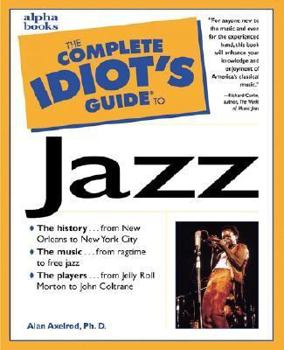
Complete Idiot's Guide to Jazz


This series of student editions of Shakespeare's most widely read plays uses a fresh approach to successfully gain the appropriate balance of emphasis between theatricality and language. Each text features gloss notes, appendices and activity suggestions and is accompanied by teacher resource material targeting the GCSE and AS assessment objectives to support the teaching of the play.
Format:Paperback
Language:English
ISBN:0028627318
ISBN13:9780028627311
Release Date:January 1999
Publisher:Alpha Books
Length:347 Pages
Weight:1.40 lbs.
Dimensions:9.5" x 1.0" x 7.5"
Customer Reviews
5 ratings
Friendly, yet detailed, history to present day of Jazz
Published by Thriftbooks.com User , 20 years ago
Ever wonder why Miles Davis is so revered among Jazz fans? Was Charlie Parker one of the guys who lasted decades or died too young? What was Louis Armstrong's major contribution to jazz development? How should I start my jazz collection and do it economically? Which instruments can be used to play jazz and which cannot? What is really the difference between jazz and popular anyway? Where is jazz headed and what's happening with it now? If you ask questions like these, then this Idiot's Guide to Jazz is for you (and me). There is also good historical depth/anecdotes that may interest more experienced jazz fans, but the book's primary purpose is to help those of us who find jazz mostly bewildering but have heard enough we like to be somewhat interested. The first 20% of the book doesn't just jump straight into history but provides a gentle introduction for a present day audience who may just be wondering what jazz is (high level), where to go to hear it, what instruments are popular (or possible - basically anything goes). Describes the general shape of the spirit of jazz, why it is unique and worthy of further investigation. The remaining 250 pages really make an easy reading, accessible chronological history of jazz starting all the way back, not just too New Orleans but Africa and Europe. From those roots it gradually builds up the story of jazz and its major artists/style/hotbeds, etc. Jazz before and after Armstrong, New York, Kansas City, Miles Davis. How each artist and location affected the sound, how swing, bebop, cool, hard bop, fusion, avant-garde came about, etc. it's all here. I have a much better picture now of what era and phase of development I am hearing when I listen to any major artist, from any era. There are still some fine points, especially on someone like Miles Davis since he morphed through three or four different phases, but at least I know that much now. The book is a good reference to learn from after the first reading as well. The author has a background as a historian apart from jazz so he is skilled at getting below the popular jazz critic understanding of events like WWII to some interesting analysis that really makes sense. Jazz really is a reflection of the American experience both good and bad. He does a terrific job of showing this. The author is very open to all sorts of jazz. Not a high brow, jazz clique type, he really wants more people to learn how to enjoy jazz. But he's not just mush either. He offers enough informed opinion to help guide you through what you might like and might not. As you can see I like the book and have found it very helpful. My only criticisms are minor. I wish there was a listening guide CD to go with the book. The problem is, the story is so comprehensive that one CD would really not be enough (two or three minimum) so the price would be much higher. Just a wishful thought, but it would really help. I thought the early part of the history dragged just a bit, may
A Difficult Subject Handled Expertly
Published by Thriftbooks.com User , 23 years ago
The task is an enormous one: How to explain jazz to someone who has little or no understanding of the musical genre. Just what is jazz? Maybe it really is a question that can only be answered by the famous Louis Armstrong quote, "If you've gotta ask, you'll never know."But give Axelrod credit. He gives the subject expert treatment. Whether you know absolutely nothing about jazz (or any music, for that matter), or whether you have a degree in music, you'll learn plenty in this well-formatted book. The author wisely gives readers a general overview of what constitutes jazz, what some of the major trends were, and a who's who of famous musicians. Axelrod does NOT immediately launch into a chronological history of jazz and that's a plus. Jazz does not have cut-and-dried periods. It's style changes intertwine and sometimes reemerge after years (and decades) of inactivity. After the first few chapters when Axelrod DOES get into more of a chronological look at jazz, it makes more sense. The foundation he has built can withstand a look at the various subgenres at that point. This makes for a much clearer reading and understanding of jazz. Axelrod gives brief bios of the major players and band leaders. If you want to know more, he tells you where you can continue your search. Also very helpful is a listing of 25 "must have" recordings for the beginner, and an expanded list for those ready to branch out. Also provided are glossaries of musicians and jazz terms. Some critics have knocked the book for not providing a sampler CD. Let me point out that the outstanding Ken Burns 5 CD boxed set covering the history of jazz barely scratches the surface. A "sampler" CD just won't do. A great book for the beginning, intermediate, or veteran jazz fan. approx. 300 pages
Wonderful Book for Jazz enthusiasts
Published by Thriftbooks.com User , 24 years ago
I would like to thank Dr. Axelrod for such an initiative. If I were any Music educational authority I would insist that this book becomes compulsory text book for any secondary school student...Musician or otherwise!
Don't be an idiot anymore!
Published by Thriftbooks.com User , 25 years ago
A must-have for anyone who never understood jazz, containing: 1) basic musical concepts; 2) jazz history; 3) major schools (styles), musicians and albums; 4) who's who in jazz; 5) essential jazz albums list; 6) complete idiot's reference card (styles and albums checklist).Read it and you will learn about all the different jazz styles and get tips to find the music that better suits your taste and build a jazz collection.P.S.: Despite the author's affirmation on page 225, Carmen Miranda was not actually brazilian. She was born in Portugal and moved to Brazil very young.
Better than the Dummies Book
Published by Thriftbooks.com User , 26 years ago
This is a good overview of jazz history told more or less chronologically with overviews of the major players. Although it would have been nice to have a CD with samples of the music like the Dummies book, this is the better book of the two.
Copyright © 2026 Thriftbooks.com
Terms of Use | Privacy Policy | Do Not Sell/Share My Personal Information | Cookie Policy | Cookie Preferences | Accessibility Statement
ThriftBooks ® and the ThriftBooks ® logo are registered trademarks of Thrift Books Global, LLC
ThriftBooks ® and the ThriftBooks ® logo are registered trademarks of Thrift Books Global, LLC
