


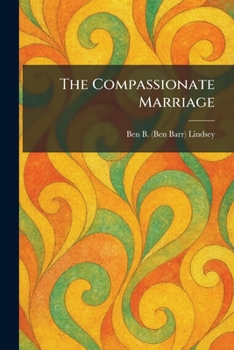
The Compassionate Marriage

"The Companionsate Marriage" is a landmark sociological and legal exploration written by Judge Ben B. Lindsey, a prominent figure in the American progressive movement. The work proposes a radical restructuring of the institution of marriage to better suit the realities of modern life in the early 20th century. Lindsey argues for a form of legal union characterized by mutual consent, the intentional use of birth control, and the right to divorce by mutual agreement, provided no children are involved.
Drawing from his extensive experience as a juvenile court judge, Lindsey provides a provocative analysis of the social pressures, economic shifts, and changing moral standards affecting young couples in the 1920s. He advocates for a more honest and transparent approach to domestic relationships, suggesting that the traditional rigidities of marriage often lead to hypocrisy and social instability. Ben B. Lindsey's insights offer a fascinating window into the evolution of American family dynamics and the historical roots of contemporary debates surrounding reproductive rights and divorce law. This work remains an essential text for understanding the transition from Victorian social codes to the liberalized attitudes of the modern era, emphasizing the necessity of adapting legal frameworks to the lived experiences of individuals.
This work has been selected by scholars as being culturally important, and is part of the knowledge base of civilization as we know it. This work was reproduced from the original artifact, and remains as true to the original work as possible. Therefore, you may see the original copyright references, library stamps (as most of these works have been housed in our most important libraries around the world), and other notations in the work.
This work is in the public domain in the United States of America, and possibly other nations. Within the United States, you may freely copy and distribute this work, as no entity (individual or corporate) has a copyright on the body of the work.
As a reproduction of a historical artifact, this work may contain missing or blurred pages, poor pictures, errant marks, etc. Scholars believe, and we concur, that this work is important enough to be preserved, reproduced, and made generally available to the public. We appreciate your support of the preservation process, and thank you for being an important part of keeping this knowledge alive and relevant.
Customer Reviews
ThriftBooks ® and the ThriftBooks ® logo are registered trademarks of Thrift Books Global, LLC
