
Skip to content
Scan a barcode
Scan
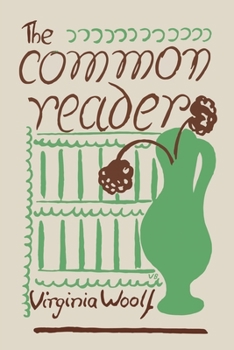
Paperback The Common Reader: First Series Book

ISBN: 1684225310

ISBN13: 9781684225316

The Common Reader: First Series

Select Format

Select Condition ThriftBooks Help Icon

Recommended

Format: Paperback

Condition: New

$14.78
Ships within 2-3 days
Save to List

Book Overview

2021 Reprint of the 1925 Edition. The Common Reader, a collection of essays by Virginia Woolf, was published in two series, the first in 1925 and the second in 1932. This edition reprints the first series, first published in 1925. Most of the essays appeared originally in such publications as the Times Literary Supplement, The Nation, New Statesman, Life and Letters, Dial, Vogue, and The Yale Review. The title indicates Woolf's intention that her essays be read by the "common reader" who reads books for personal enjoyment. Using the sympathetic persona of "the common reader," Woolf treats literary topics. Woolf outlines her literary philosophy in the introductory essay to the first series, "The Common Reader," and in the concluding essay to the second series, "How Should One Read a Book?" The first series includes essays on Geoffrey Chaucer, Michel de Montaigne, Jane Austen, George Eliot, and Joseph Conrad, as well as discussions of the Greek language and the modern essay.

Content:

The common reader -- The Pastons and Chaucer -- On not knowing Greek -- The Elizabethan lumber room -- Notes on an Elizabethan play -- Montaigne -- The Duchess of Newcastle -- Rambling round Evelyn -- Defoe -- Addison -- The lives of the obscure: The Taylors and the Edgeworths. Laetitia Pilkington. Miss Ormerod -- Jane Austen -- Modern fiction -- "Jane Eyre" and "Wuthering Heights" -- George Eliot -- The Russian point of view -- Outlines: Miss Mitford. Dr. Bentley. Lady Dorothy Nevill. Archbishop Thomson -- The patron and the crocus -- The modern essay -- Joseph Conrad -- How it strikes a contemporary.

Customer Reviews

2 ratings

An uncommon writer and the common reader

In the opening essay in this book Woolf tells us she is writing for the common reader. The common reader is not the critic and not the scholar."He is worse educated, and nature has not gifted him so generously. He reads for his own pleasure rather than to impart knowledge or correct the opinions of others. Above all, he is guided by an instinct to create for himself, out of whatever odds and ends he can come by, some kind of whole- a portrait of a man, a sketch of an age, a theory of the art of writing." Woolf then goes on in the subsequent essays to write of Chaucer, Jane Austen, Joseph Conrad, Montaigne, George Eliot, Defoe, Addison, 'Modern Fiction' 'The Lives of the Obscure' ' Jane Eyre and Wuthering Heights' 'The Russian Point of View'. She writes with a special kind of insight and artfulness. I especially liked her essay on Montaigne who she sees as one of the few writers who truly makes a portrait of himself, and writes truly of the whole of his experience. She sees him as one who knew not only how to communicate himself but to be himself, who defied convention and ceremony, and prizing contemplation and retirement made a book which was himself. It can be said that Woolf in a way does the same with these reflections upon others which hold up a mirror to her own masterfully insightful sensibility.

Uncommonly Good Read

You start out wanting to like this author. She has a witty, humorous way with words, a reverence for the written word and a telling grasp of what distinguishes writers of various eras. Of Elizabethan dramatists, she writes, "Theirs is the word coining genius, as if thought plunged into a sea of words and came up dripping." She writes about Classical Greek damatists as one who understands what separates them from all writers who follow: "To understand him," she says of Aeschylus, "is is necessary to take that dangerous leap through the air without the support of words ... for words, when opposed to such a blast of meaning, must give out, must be blown astray..." For her, the best writing, whether that of a Greek or an Englishman, has a meaning that defies words, a meaning that we percieve in the mind -- without words. Coming down the centuries and pausing to consider Jane Austen, she captures the essential writer in terms that encourage and enlarge: "Think away the surface animation, the likeness to life, and there remains, to provide a deeper pleasure, an exquisite discriminaiton of human values." Along with her interest in the well known (she treats many more than the few mentioned here)she has a teasing regard for near greats and nobodies, whose seldom touched books rest in near oblivion. Of the memoirs of one, Laetitia Pilkington, she writes: "... the dust lies heavy on her tomb ... nobody has read her since early in the last century when a reader ... left off in the middle and marked her place with a faded list of goods and groceries." Nor is it just to have a chuckle that she looks at such relative unknowns, but to give us a look at their pained and frequently bereft lives. Laetitia Pilkington was badly used by men in her life. Woolf has a compassion for such women. You begin by wanting to like this woman who claims it's the common reader who makes or breaks an author. As you read on, you find yourself happily taken in and smiling at her wit, humor and insight.
Copyright © 2026 Thriftbooks.com Terms of Use | Privacy Policy | Do Not Sell/Share My Personal Information | Cookie Policy | Cookie Preferences | Accessibility Statement
ThriftBooks® and the ThriftBooks® logo are registered trademarks of Thrift Books Global, LLC

GoDaddy Verified and Secured