


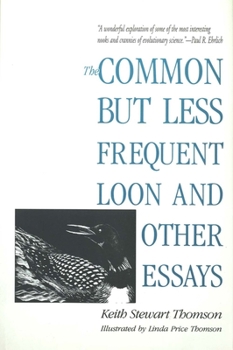
The Common But Less Frequent Loon and Other Essays

Select Format
Select Condition 
Book Overview
From an acclaimed biologist, a view of science as a great intellectual adventure "Thomson loves biology and literature with equal passion. . . . Writing with rare eloquence, he mourns the current death of literary merit in scientific literature, drawing a parallel between the demise of cogent expression and the fate of the loons on his favorite New Hampshire lake."--Charles Solomon, Los Angeles Times The great Piltdown fraud, the mystery of how a shark swims with an asymmetric tail, the debate over dinosaur extinction, the haunting beauty of a loon on a northern lake--these are only a few of the subjects discussed by Keith Stewart Thomson in this wide-ranging book. At once instructive and entertaining, the book celebrates the aesthetic, literary, and intellectual aspects of science and conveys what is involved in being a scientist today--the excitement of discovery and puzzle solving, the debate over what to read and what to write, and the element of promotion that seems to be necessary to stimulate research and funding. Keith Thomson, a well-known biologist who writes a column for the distinguished bimonthly magazine American Scientist, here presents some of his favorite essays from that periodical in a book of three parts, each introduced by a new essay. In the first section, "The Uses of Diversity," he ponders such questions as why we care passionately and expensively about the dusky seaside sparrow and how and why we rescued the flowering tree Franklinia from extinction. The second section, "On Being a Scientist," includes an autobiographical account of Thomson's life and his views on what makes being a scientist special and interesting. The last section, "The Future of Evolution," gives examples of how the study of evolution is entering one of the most dramatic stages in its own development. Thomson presents science as a great intellectual adventure--a search of why things are as they are--most rewarding when it is accompanied by an appreciation of the subtleties and aesthetic qualities of the objects studied. His book will enable nonscientists to open their minds to the pleasures of science and scientists to become more articulate and passionate about what they do.
Format:Paperback
Language:English
ISBN:0300066546
ISBN13:9780300066548
Release Date:February 1996
Publisher:Yale University Press
Length:200 Pages
Weight:0.75 lbs.
Dimensions:0.7" x 5.8" x 8.9"
Customer Reviews
1 rating
Ruminations on past and future
Published by Thriftbooks.com User , 21 years ago
Thomson's collection of essays on natural science (from "American Scientist") are contemplative, and conversational, cerebral without being difficult, and concerned with ideas, philosophy and language. Organized in three sections, "The Uses of Diversity," "On Being a Scientist" and "The Future of Evolution," the collection takes a broad perspective. In the title essay he extrapolates from the pair of loons on his summer lake to the character of a place where loons live, their dwindling numbers and what that could mean to humans, practically and aesthetically. On a drive from Kennedy airport, he muses on our attitude toward land. Two other essays explore the perspectives of earlier scientists. In the second section he captures the thrill of discovering how sharks swim and dissects the polarizing effect of "reductionism," the practice of ignoring outside influences in scientific disciplines. Reflections on evolution lead him to explore matters as apparently diverse as the origin of tetrapods and the link between Newton and Darwin. Thomson offers ruminations rather than anecdotes, he looks at where we've been as well as where we're going and worries about how we're getting there.
Copyright © 2026 Thriftbooks.com Terms of Use
| Privacy Policy | Do Not
Sell/Share My Personal Information | Cookie Policy | Cookie Preferences | Accessibility Statement
ThriftBooks® and the ThriftBooks® logo are registered trademarks of Thrift Books Global, LLC
ThriftBooks® and the ThriftBooks® logo are registered trademarks of Thrift Books Global, LLC
