


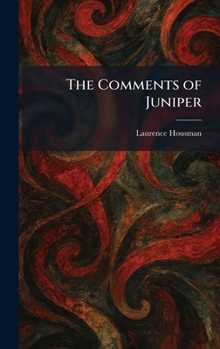
The Comments of Juniper

"The Comments of Juniper" is a compelling collection of plays by the renowned author and dramatist Laurence Housman. Centered on the early Franciscan movement, the work brings to life the stories of Saint Francis of Assisi and his devoted follower, Brother Juniper. Known for his "holy simplicity" and literal interpretation of Christian charity, Brother Juniper serves as a poignant and often humorous lens through which the radical spirituality of the Franciscan order is examined.
Across these six dramatic pieces, Housman captures the deep bond between the saint and his disciples, emphasizing themes of absolute poverty, unwavering faith, and the joy of spiritual devotion. The dialogue reflects the mystical and human qualities of the historical figures, making the work both a literary achievement and a profound exploration of religious character. "The Comments of Juniper" remains a significant contribution to early 20th-century religious drama, showcasing Housman's ability to blend historical lore with lyrical sensitivity and deep empathy for the Franciscan tradition.
This work has been selected by scholars as being culturally important, and is part of the knowledge base of civilization as we know it. This work was reproduced from the original artifact, and remains as true to the original work as possible. Therefore, you may see the original copyright references, library stamps (as most of these works have been housed in our most important libraries around the world), and other notations in the work.
This work is in the public domain in the United States of America, and possibly other nations. Within the United States, you may freely copy and distribute this work, as no entity (individual or corporate) has a copyright on the body of the work.
As a reproduction of a historical artifact, this work may contain missing or blurred pages, poor pictures, errant marks, etc. Scholars believe, and we concur, that this work is important enough to be preserved, reproduced, and made generally available to the public. We appreciate your support of the preservation process, and thank you for being an important part of keeping this knowledge alive and relevant.
Customer Reviews
ThriftBooks ® and the ThriftBooks ® logo are registered trademarks of Thrift Books Global, LLC
