


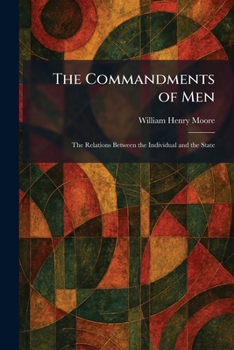
The Commandments of Men: The Relations Between the Individual and the State

"The Commandments of Men" is a profound exploration of the intricate and often contentious relationship between the individual and the state. Written during a pivotal era of political and social transformation, William Henry Moore's work delves into the philosophical and legal foundations that define the boundaries of government authority and the inherent rights of the citizen. The book examines the growing tension between legislative mandates-the titular "commandments" imposed by human institutions-and the moral or natural liberties of the person.
Moore provides a rigorous analysis of how the expansion of state power impacts personal freedom and the broader social order. Through a lens that is both historical and legalistic, the text challenges readers to consider the source of law's legitimacy and the point at which state intervention begins to compromise individual autonomy. This treatise remains a significant contribution to political science and legal philosophy, offering timeless insights into the balance of power within a democratic society. It is an essential read for scholars and students interested in civil liberties, the evolution of government, and the enduring debate over the limits of political control.
This work has been selected by scholars as being culturally important, and is part of the knowledge base of civilization as we know it. This work was reproduced from the original artifact, and remains as true to the original work as possible. Therefore, you may see the original copyright references, library stamps (as most of these works have been housed in our most important libraries around the world), and other notations in the work.
This work is in the public domain in the United States of America, and possibly other nations. Within the United States, you may freely copy and distribute this work, as no entity (individual or corporate) has a copyright on the body of the work.
As a reproduction of a historical artifact, this work may contain missing or blurred pages, poor pictures, errant marks, etc. Scholars believe, and we concur, that this work is important enough to be preserved, reproduced, and made generally available to the public. We appreciate your support of the preservation process, and thank you for being an important part of keeping this knowledge alive and relevant.
Customer Reviews
ThriftBooks ® and the ThriftBooks ® logo are registered trademarks of Thrift Books Global, LLC
