


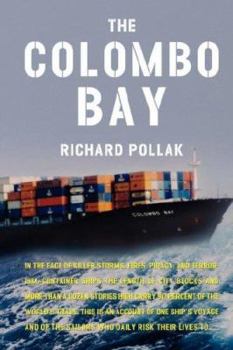
The Colombo Bay

Select Format
Select Condition 
Book Overview
In the face of killer storms, fires, piracy, and terrorism, container ships the length of city blocks and more than a dozen stories high carry 90 percent of the worlds trade. This is an account of one ship's voyage and of the sailors who daily risk their lives to deliver six million containers a year to United States ports alone. Inside these twenty-foot and forty-foot steel boxes are the thousands of imports -- from chinos and Game Boys to garlic and frozen shrimp -- without which North America's consumer society would collapse. To explore this little-known and dangerous universe of modern seafaring, Richard Pollak joined the Colombo Bay in Hong Kong and over the next five weeks sailed with her and her 3,500 containers across the South China Sea, the Indian Ocean, the Mediterranean, and the Atlantic. En route, this mammoth vessel called at Singapore and Colombo, passed through the Suez Canal (toll: $250,000), then put in at Malta and Halifax before tangling with Hurricane Karen on the two-day run to New York. Here is the story of the ship's unheralded twenty-four-man company; of the unflappable British captain, Peter Davies, a veteran of four decades at sea; of Federico Castrojas, who like the rest of the hard-working Filipino crew must daily confront the loneliness of being away from his family for nine months at a stretch; of Simon Westall, the twenty-one-year-old third mate, who reveals what it is like to be gay in the broad-shouldered world of the merchant service. It is a world where pirates in the Malacca Strait sneak up behind ships at night in fast power boats, then clamber aboard and either rob the unarmed sailors at gunpoint and escape into the dark or throw the crew into the sea and hijack the ship, plundering her cargo and sometimes repainting her and setting out to do business under another name and flag. It is a world where families desperate to get to the United States or Europe pay thousands of dollars to the Chinese Snakeheads and other criminal gangs, who secrete these wretched migrants in stifling containers; after a week or more at sea these stowaways arrive in the Promised Land either starving or dead. Pollak sailed on September 13, 2001, into a changed world, on one of 7,000 container ships whose millions of uninspected boxes suddenly had become potential Trojan horses in which terrorists could transport weapons of mass destruction into the heart of the United States. Throughout his riveting narrative, Pollak interweaves the insights of Herman Melville and Joseph Conrad, whose masterful portrayals of seafaring make the voyage of the Colombo Bay a dramatic reminder of what a hard and rarely reported life merchant seamen have always led out on the "unhooped oceans of this planet."
Format:Paperback
Language:English
ISBN:1416568107
ISBN13:9781416568100
Release Date:January 1
Publisher:Simon & Schuster
Length:260 Pages
Weight:0.74 lbs.
Dimensions:0.7" x 6.0" x 9.0"
Customer Reviews
5 ratings
Great book!
Published by Thriftbooks.com User , 21 years ago
This is a terrific book, and comparisons to John McPhee are apt. The writing is excellent, and Pollak takes a subject the reader might not think he'll be interested in (container ships) and makes it fascinating (much like McPhee's Oranges). Well worth reading.
Ever wonder where stuff comes from ?
Published by Thriftbooks.com User , 22 years ago
Well at least did you wonder where and how all those containers move around and who is APL/P & O/Maersk? I regularly did, traveling everyday to New York from New Jersey. I also saw them in the Bombay dockyards and in many many Bollywood films. It is the preferred place for all movie villains to bump off a person in Bollywood movies (with some hide and seek and jumping involved before the ultimate sacrifice). As the other reviewers pointed out, has statistics, human aspect, politics, history and literature interwoven to make an interesting story.
The Colombo Bay, Welcome Aboard
Published by Thriftbooks.com User , 22 years ago
Richard Pollak managed to capture the human side of the people onboard in his book The Colombo Bay. It is a great book however I didn't care for the history he mixes into the book and the quotes from other authors. For the rest it is a book that lets you feel the journey, from the conversations with the crew to the short trips on land it all feels real and after finishing the book I had besides an understanding of the importance of container ships in the world trade, also a human feeling about the people who actually live on these boats nine months at a time. Overall a great book and a good read.
A Modern High Seas Adventure
Published by Thriftbooks.com User , 22 years ago
Richard Pollak, a writer with no previous nautical bent, got interested in the marine shipping business for no particular reason except curiosity. A friend became a vice president at P & O Nedlloyd which has a fleet of container ships sailing all over the world, and Pollak asked to book passage in one of them. He left for Hong Kong to board The _Colombo Bay_ carrying a landlubber's baggage including books by Conrad and Melville, CDs of music by Rossini and by Sondheim, and the sort of innocence we all had on 10 September 2001. In _The Colombo Bay_ (Simon & Schuster), Pollak relates how he was asleep in his hotel in Hong Kong and his family was in New York when the World Trade Center towers fell. His family was all right, but the voyage and book project that he had so looked forward to now appeared "indulgent and worse, irrelevant." He wanted to go home, but his wife talked him out of it, and he shipped out. It is good that he did. He didn't know much about the shipping industry when he started, and he learned a lot, and shares it with good humor and the sort of careful explication one expects in, say, a book by John McPhee. Most of the rest of us are ignorant about container shipping, and we shouldn't be. It affects us all. Almost undoubtedly in the very clothes you are wearing are plenty of items that came by container ship, and you own plenty of similar goods all around your house from Asia and the rest of the world. The containers keep the ships at sea, rather than spending time loading and unloading in port. They have to be stowed by computer, to keep the ship balanced, to keep the ones that will be offloaded soon near the top, to keep dangerous contents separated, and so on. The work is dangerous, and as Pollak considers during the weeks after the 9-11 attacks, the dangers have gotten greater. "Flags of Convenience" vessels are registered in countries with minimal shipping industry, and also minimal attention to maintenance, safety, and professional manning. Such vessels would be easy targets for terrorists who wish to tamper with the cargo, or slip a dirty bomb into the thousands of tons of commercial goods. There is a simple threat of piracy, which actually changes some of the routing of Pollak's ship. There are no firearms aboard the ship, reflecting the policy of most liner companies which oblige rather than confront boarded pirates. Pollak has loaded his narrative with facts. The sludge residue from the burned ship's oil used to be a nuisance that had to be cleaned out periodically, but now such removal is done by specialists who use the sludge in such alchemy as cracking fuels. Pollak feeds a pair of crows that have mistakenly boarded the ship in Colombo, and unable to go anywhere else, stay on for 4,000 miles to Suez. Among the goods carried by the ship are cartons of Marlboro cigarettes, which seem to be an internationally accepted present for, say, quarantine officials who need to be persuaded to hurry abo
Not bad for a landlubber
Published by Thriftbooks.com User , 22 years ago
For a landlubber he does a pretty good job of capturing life in the modern merchant marine and the "hidden" phenomena of how goods are moved across the globe. After having spent 12 years in the merchant marine, albeit on oil tankers, and another 8 as a ship pilot, it is unusual to find someone who is not connected with the industry, get the "feeling" of being at sea correct.In today's world the romance of going to sea is almost completely gone, replaced by the need to have cargo moved cheaply and quickly from point A to B. The size of crews are being reduced all the time while the work load for those remaining is increased, leading to greater fatigue and the more likely chance of an accident happening, no matter how good the crew is.The book will educate as well as entertain and give the reader a glimpse into a world few get to participate in.
Copyright © 2026 Thriftbooks.com
Terms of Use | Privacy Policy | Do Not Sell/Share My Personal Information | Cookie Policy | Cookie Preferences | Accessibility Statement
ThriftBooks ® and the ThriftBooks ® logo are registered trademarks of Thrift Books Global, LLC
ThriftBooks ® and the ThriftBooks ® logo are registered trademarks of Thrift Books Global, LLC
