


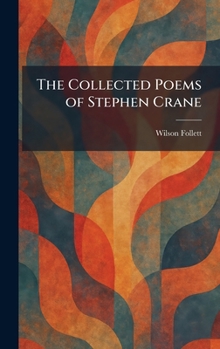
The Collected Poems of Stephen Crane

"The Collected Poems of Stephen Crane" brings together the stark, unconventional, and visionary verse of one of America's most influential literary figures. Primarily known for his prose, Stephen Crane was also a pioneering poet whose work defied the rhythmic and structural conventions of the late 19th century. This collection encompasses his major poetic output, including his most famous volumes "The Black Riders and Other Lines" and "War Is Kind," showcasing a style characterized by brevity, irony, and intense emotional honesty.
Crane's poetry explores themes of religious doubt, the indifference of nature, the cruelty of war, and the complexities of the human condition. Eschewing traditional rhyme and meter, his short, punchy lines resemble modern free verse, making him a significant precursor to the Imagist movement. The poems are often brief, parable-like, and bitingly philosophical, offering readers a glimpse into a mind that viewed the world with raw, uncompromising clarity.
This compilation serves as a comprehensive look at Crane's contribution to American literature, revealing the depth of his poetic voice beyond his famous novels. It remains an essential read for those interested in the transition from Victorian verse to the experimental styles of 20th-century modernism.
This work has been selected by scholars as being culturally important, and is part of the knowledge base of civilization as we know it. This work was reproduced from the original artifact, and remains as true to the original work as possible. Therefore, you may see the original copyright references, library stamps (as most of these works have been housed in our most important libraries around the world), and other notations in the work.
This work is in the public domain in the United States of America, and possibly other nations. Within the United States, you may freely copy and distribute this work, as no entity (individual or corporate) has a copyright on the body of the work.
As a reproduction of a historical artifact, this work may contain missing or blurred pages, poor pictures, errant marks, etc. Scholars believe, and we concur, that this work is important enough to be preserved, reproduced, and made generally available to the public. We appreciate your support of the preservation process, and thank you for being an important part of keeping this knowledge alive and relevant.
Customer Reviews
ThriftBooks ® and the ThriftBooks ® logo are registered trademarks of Thrift Books Global, LLC
