


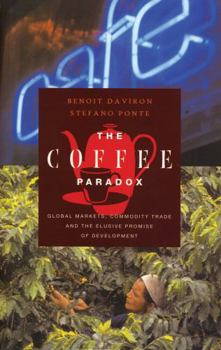
The Coffee Paradox: Global Markets, Commodity Trade and the Elusive Promise of Development

Select Format
Select Condition 
Book Overview
Can developing countries trade their way out of poverty? International trade has grown dramatically in the last two decades in the global economy, and trade is an important source of revenue in developing countries. Yet, many low-income countries have been producing and exporting tropical commodities for a long time. They are still poor. This book is a major analytical contribution to understanding commodity production and trade, as well as putting forward policy-relevant suggestions for 'solving' the commodity problem. Through the study of the global value chain for coffee, the authors recast the 'development problem' for countries relying on commodity exports in entirely new ways. They do so by analysing the so-called coffee paradox - the coexistence of a 'coffee boom' in consuming countries and of a 'coffee crisis' in producing countries. New consumption patterns have emerged with the growing importance of specialty, fair trade and other 'sustainable' coffees. In consuming countries, coffee has become a fashionable drink and coffee bar chains have expanded rapidly. At the same time, international coffee prices have fallen dramatically and producers receive the lowest prices in decades. This book shows that the coffee paradox exists because what farmers sell and what consumers buy are becoming increasingly 'different' coffees. It is not material quality that contemporary coffee consumers pay for, but mostly symbolic quality and in-person services. As long as coffee farmers and their organizations do not control at least parts of this 'immaterial' production, they will keep receiving low prices. The Coffee Paradox seeks ways out from this situation by addressing some key questions: What kinds of quality attributes are combined in a coffee cup or coffee package? Who is producing these attributes? How can part of these attributes be produced by developing country farmers? To what extent are specialty and sustainable coffees achieving these objectives?
Format:Paperback
Language:English
ISBN:1842774573
ISBN13:9781842774571
Release Date:November 2005
Publisher:Zed Books
Length:320 Pages
Weight:0.90 lbs.
Dimensions:0.7" x 5.6" x 8.5"
Customer Reviews
1 rating
The answer to the coffee question
Published by Thriftbooks.com User , 19 years ago
Fair trade and organic coffee is seen by many as the solution to poverty among coffee farmers of the South, although these are excellent solutions for a group of coffee producers they leave out the vast majority of producers. Ponte and Daviron outline what other possible solutions are available to solve the problem. These solutions could ideally reach the majority of coffee producers. I would recomend this book to anyone interested in coffee and the quality of life of producers of the global South.
Copyright © 2026 Thriftbooks.com
Terms of Use | Privacy Policy | Do Not Sell/Share My Personal Information | Cookie Notice | Cookie Preferences | Accessibility Statement
ThriftBooks ® and the ThriftBooks ® logo are registered trademarks of Thrift Books Global, LLC
ThriftBooks ® and the ThriftBooks ® logo are registered trademarks of Thrift Books Global, LLC
