


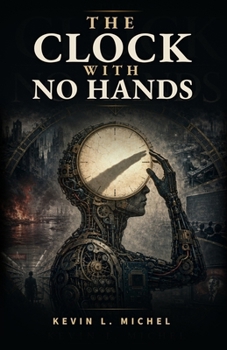
The Clock with No Hands

The Clock with No Hands is a surreal, first-person, metaphysical-philosophical novella by Kevin L. Michel. It follows the author moving through a sequence of impossible but concrete symbolic spaces: a giant clock without hands, a fence with a snake, a ship's wake, a factory, a tank crossing the steppe, a burning city, a ruined school, a screen, a supermarket, a court, and finally the clock again.
The central idea is that human beings build systems, then mistake those systems for fate. The clock has no hands because civilization has lost or hidden its agency. Throughout the book, we encounter institutions that separate action from consequence: factories separate workers from meaning, offices turn wounds into charts, war converts homes into tactics, schools train obedience, screens harvest attention, supermarkets disguise constraint as choice, and machines execute purposes humans refuse to own.
The tone is haunting, intense, wise, allegorical, and morally serious. It is a dark pilgrimage through history, technology, labor, war, propaganda, consumer life, and responsibility.
The book's final push is toward agency. It does not claim the world is easily saved. Instead, it insists that the future is not an automatic mechanism. Systems have authors. Machines have purposes. Delay has consequences. The missing hand is not history, fate, or technology. It is the human hand raised in responsibility.
Customer Reviews
ThriftBooks ® and the ThriftBooks ® logo are registered trademarks of Thrift Books Global, LLC
