


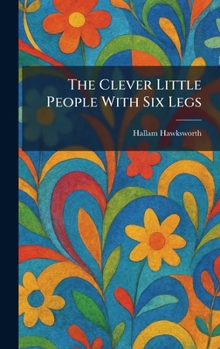
The Clever Little People With Six Legs

"The Clever Little People With Six Legs" is an engaging and educational exploration of the world of insects, designed to capture the imagination of readers. Hallam Hawksworth invites audiences to look closer at the bustling lives of the tiny creatures that share our environment, framing the study of entomology as a series of fascinating adventures. The book delves into the complex social structures, survival strategies, and remarkable physical adaptations of various six-legged inhabitants of the natural world.
From the industrious ant to the architectural prowess of bees, the narrative highlights the intelligence and ingenuity found in nature's smallest wonders. By blending scientific observation with a compelling prose style, the work encourages a deep curiosity about biology and the environment. "The Clever Little People With Six Legs" serves as a timeless guide to the miniature kingdoms beneath our feet, fostering an appreciation for the diversity and complexity of life on Earth. This work remains a classic example of nature writing that makes the scientific world accessible and enchanting for those eager to learn about the wonders of natural history.
This work has been selected by scholars as being culturally important, and is part of the knowledge base of civilization as we know it. This work was reproduced from the original artifact, and remains as true to the original work as possible. Therefore, you may see the original copyright references, library stamps (as most of these works have been housed in our most important libraries around the world), and other notations in the work.
This work is in the public domain in the United States of America, and possibly other nations. Within the United States, you may freely copy and distribute this work, as no entity (individual or corporate) has a copyright on the body of the work.
As a reproduction of a historical artifact, this work may contain missing or blurred pages, poor pictures, errant marks, etc. Scholars believe, and we concur, that this work is important enough to be preserved, reproduced, and made generally available to the public. We appreciate your support of the preservation process, and thank you for being an important part of keeping this knowledge alive and relevant.
Customer Reviews
ThriftBooks ® and the ThriftBooks ® logo are registered trademarks of Thrift Books Global, LLC
