


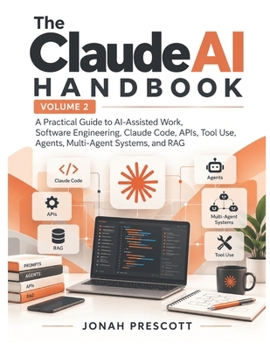
The Claude AI Handbook - Volume 2: A Practical Guide to AI-Assisted Work, Software Engineering, Claude Code, APIs, Tool Use, Agents, Multi-Agent Syste

Claude becomes significantly more powerful when it is integrated into real workflows, software systems, tools, repositories, APIs, and enterprise knowledge. But building useful AI applications requires more than sending prompts to a model. It requires architecture, context management, validation, security boundaries, state management, and controlled execution.
The Claude AI Handbook - Volume 2 moves from understanding Claude to building with it. This volume provides a practical, technically grounded guide to using Claude for professional work, software engineering, application development, tool integration, agentic workflows, multi-agent systems, and retrieval-augmented generation.
You will learn how to:
- Use Claude for professional writing, editing, document intelligence, business analysis, and knowledge work
- Analyze structured data, spreadsheets, CSV files, and unstructured information
- Apply Claude to software engineering, debugging, refactoring, code review, documentation, and testing
- Work with real-world repositories and understand repository-level development
- Use Claude Code for planning, implementing, testing, and reviewing software changes
- Understand the Claude API, requests, responses, authentication, streaming, structured outputs, and error handling
- Design applications that combine Claude with deterministic business logic and validation
- Manage prompts, context, conversation state, sessions, and application workflows
- Integrate Claude with APIs, databases, external services, and enterprise systems through controlled tools
- Design safe multi-step tool workflows with authorization, validation, idempotency, and auditability
- Understand what makes an AI agent and how planning, execution loops, memory, state, and tools work together
- Build reliable Claude agents with guardrails, budgets, human approval, and controlled autonomy
- Design specialist, supervisor, and multi-agent architectures
- Understand multi-agent failure modes, shared state, delegation, coordination, and recovery
- Build retrieval-augmented generation systems for enterprise knowledge
- Design document ingestion, chunking, retrieval, ranking, context construction, and grounded generation workflows
- Improve reliability through validation, provenance, access control, and risk-based human oversight
The central principle of this volume is simple: Claude provides intelligence; the surrounding system provides control.
The book therefore treats AI applications as engineered systems rather than isolated model interactions. Model reasoning is combined with application logic, authoritative data, deterministic tools, validation, security controls, workflow state, and human approval where appropriate.
From AI Interaction to AI SystemsThis volume explains the architectural transition from asking Claude questions to building systems that use Claude as an intelligence component.
You will learn how to design workflows in which Claude can analyze, generate, plan, and propose actions while deterministic software remains responsible for authorization, business rules, state, execution, and verification.
Who This Book Is ForThis book is designed for software engineers, developers, AI engineers, architects, platform engineers, data engineers, DevOps professionals, technical leaders, AI application developers, and practitioners building agentic or RAG-based systems.
It is also useful for professionals who want to move beyond basic Claude usage and understand how AI capabilities can be integrated into real software and organizational workflows.
The Claude AI Handbook - Volume 2 provides the engineering foundation for turning Claude from a conversational capability into a component of practical, controlled, and production-oriented AI systems.
Customer Reviews
ThriftBooks ® and the ThriftBooks ® logo are registered trademarks of Thrift Books Global, LLC
