


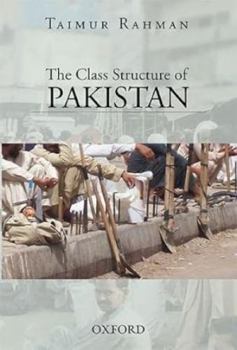
The Class Structure of Pakistan
No Customer Reviews

Select Format
Select Condition 
Book Overview
This work on the class structure of Pakistan is based on the framework of historical materialism. It sketches the history of the region that is now Pakistan and analyzes the class structure from the time of the Mughal Empire, through the distortions of the colonial era and the transition to capitalism, to the class structure of contemporary Pakistan. It avoids over-schematic arguments, attempting to proceed from facts rather than from any ideal forms. The study develops three propositions: First, that the mode of production of pre-colonial South Asia was qualitatively distinct from European feudalism; second, that the colonial path of capitalist development of South Asia resulted in a socio-economic formation that combined features of the Asiatic and capitalist modes of production, which this study terms Asiatic capitalism; third, that in Pakistan manufacturing and services are dominated by petty commodity production and small-scale capitalism. The author concludes by outlining the implications for Pakistan's politics, society, and culture.
Format:Paperback
Language:English
ISBN:0199400121
ISBN13:9780199400126
Release Date:October 2021
Publisher:Oxford University Press
Length:328 Pages
Weight:0.80 lbs.
Dimensions:0.8" x 6.2" x 9.4"
Customer Reviews
0 rating
Copyright © 2026 Thriftbooks.com
Terms of Use | Privacy Policy | Do Not Sell/Share My Personal Information | Cookie Policy | Cookie Preferences | Accessibility Statement
ThriftBooks ® and the ThriftBooks ® logo are registered trademarks of Thrift Books Global, LLC
ThriftBooks ® and the ThriftBooks ® logo are registered trademarks of Thrift Books Global, LLC
