


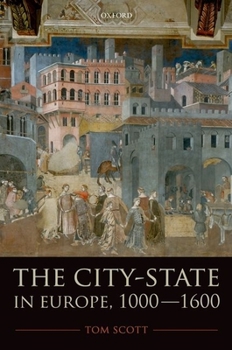
The City-State in Europe, 1000-1600: Hinterland, Territory, Region
No Customer Reviews

Select Format
Select Condition 
Book Overview
No detailed comparison of the city-state in medieval Europe has been undertaken over the last century. Research has concentrated on the role of city-states and their republican polities as harbingers of the modern state, or else on their artistic and cultural achievements, above all in Italy. Much less attention has been devoted to the cities' territorial expansion: why, how, and with what consequences cities in the urban belt, stretching from central and northern Italy over the Alps to Switzerland, Germany, and the low countries, succeeded (or failed) in constructing sovereign polities, with or without dependent territories. Tom Scott goes beyond the customary focus on the leading Italian city-states to include, for the first time, detailed coverage of the Swiss city-states and the imperial cities of Germany. He criticizes current typologies of the city-state in Europe advanced by political and social scientists to suggest that the city-state was not a spent force in early modern Europe, but rather survived by transformation and adaption. He puts forward instead a typology which embraces both time and space by arguing for a regional framework for analysis which does not treat city-states in isolation but within a wider geopolitical setting.
Format:Hardcover
Language:English
ISBN:0199274606
ISBN13:9780199274604
Release Date:March 2012
Publisher:Oxford University Press, USA
Length:416 Pages
Weight:1.63 lbs.
Dimensions:1.1" x 6.1" x 9.2"
Related Subjects
HistoryCustomer Reviews
0 rating
Copyright © 2026 Thriftbooks.com Terms of Use
| Privacy Policy | Do Not
Sell/Share My Personal Information | Cookie Policy | Cookie Preferences | Accessibility Statement
ThriftBooks® and the ThriftBooks® logo are registered trademarks of Thrift Books Global, LLC
ThriftBooks® and the ThriftBooks® logo are registered trademarks of Thrift Books Global, LLC
