


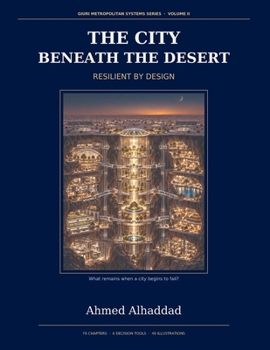
The City Beneath the Desert: Resilient by Design

Future cities are often sold through scale, speed and spectacle. This book asks a harder question: what must a city survive before architecture, capital and contracts make its weaknesses irreversible?
Using a proposed metropolitan cell beneath the desert as a test case, Ahmed Alhaddad examines power loss, water interruption, network failure, human acceptance, delivery risk, slow demand, operating cost and long-term renewal. The underground city is the memorable experiment. The method applies to any ambitious future city.
Across 76 chapters, six professional decision tools and 40 illustrations, the book shows readers how to:
- expose hidden dependencies and cascading failure;
- define essential metropolitan functions, degraded states and recovery;
- test 72-hour power and seven-day water resilience;
- prevent a technically functional city from failing its people;
- make prototype scale conditional on evidence; and
- challenge an investment thesis under combined downside.
Written for government sponsors, sovereign developers, programme directors, PMCs, investors, designers, engineers, resilience teams, operators and researchers, The City Beneath the Desert moves from the original RMC-01 vision to an evidence-refined RMC-02 proposition.
It does not claim that underground cities are automatically resilient. It demonstrates how a serious programme should test, modify, phase-or reject-its preferred idea before committing the full city.
Customer Reviews
ThriftBooks ® and the ThriftBooks ® logo are registered trademarks of Thrift Books Global, LLC
