


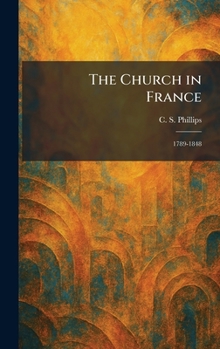
The Church in France: 1789-1848

"The Church in France 1789-1848" provides a comprehensive historical analysis of the Roman Catholic Church's evolution during one of the most turbulent periods in French history. Beginning with the outbreak of the French Revolution, C.S. Phillips examines the dramatic shifts in the relationship between the Gallican Church and the state, tracing the impact of revolutionary secularism, the Civil Constitution of the Clergy, and the subsequent dechristianization campaigns.
The narrative continues through the rise of Napoleon Bonaparte and the Concordat of 1801, which sought to restore religious order while maintaining state control. Phillips explores the complexities of the Bourbon Restoration and the July Monarchy, highlighting the internal tensions between ultramontanism and liberal Catholicism. This scholarly work delves into the lives of key ecclesiastical figures and the broader societal changes that reshaped French religious identity over six decades.
By examining the period leading up to the Revolution of 1848, the author illustrates how the Church navigated political upheaval to maintain its influence in a modernizing nation. This study remains an essential resource for those interested in the intersections of religion, politics, and social change in modern Europe.
This work has been selected by scholars as being culturally important, and is part of the knowledge base of civilization as we know it. This work was reproduced from the original artifact, and remains as true to the original work as possible. Therefore, you may see the original copyright references, library stamps (as most of these works have been housed in our most important libraries around the world), and other notations in the work.
This work is in the public domain in the United States of America, and possibly other nations. Within the United States, you may freely copy and distribute this work, as no entity (individual or corporate) has a copyright on the body of the work.
As a reproduction of a historical artifact, this work may contain missing or blurred pages, poor pictures, errant marks, etc. Scholars believe, and we concur, that this work is important enough to be preserved, reproduced, and made generally available to the public. We appreciate your support of the preservation process, and thank you for being an important part of keeping this knowledge alive and relevant.
Customer Reviews
ThriftBooks ® and the ThriftBooks ® logo are registered trademarks of Thrift Books Global, LLC
