


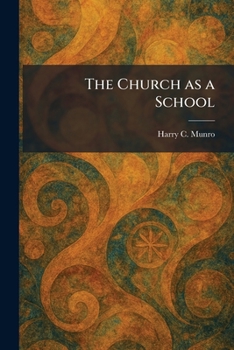
The Church as a School

"The Church as a School" explores the vital intersection of religious practice and educational theory, presenting a compelling case for the church's role as a primary site of learning and spiritual development. Harry C. Munro examines the pedagogical foundations necessary for effective Christian education, emphasizing that the mission of a faith community is fundamentally tied to its ability to teach and mentor its members.
The work outlines practical strategies for organizing church programs to function as a cohesive "school for life," focusing on character development, moral inquiry, and the integration of social and spiritual values. By viewing the church through an educational lens, Munro offers insights into curriculum planning, the training of lay leaders, and the importance of fostering a robust environment for intellectual growth within the congregation.
As a significant contribution to the field of religious pedagogy, "The Church as a School" serves as an essential resource for clergy, educators, and historians of religious instruction. It remains a thought-provoking study on how faith-based institutions can cultivate a structured yet dynamic approach to nurturing the minds and spirits of their communities.
This work has been selected by scholars as being culturally important, and is part of the knowledge base of civilization as we know it. This work was reproduced from the original artifact, and remains as true to the original work as possible. Therefore, you may see the original copyright references, library stamps (as most of these works have been housed in our most important libraries around the world), and other notations in the work.
This work is in the public domain in the United States of America, and possibly other nations. Within the United States, you may freely copy and distribute this work, as no entity (individual or corporate) has a copyright on the body of the work.
As a reproduction of a historical artifact, this work may contain missing or blurred pages, poor pictures, errant marks, etc. Scholars believe, and we concur, that this work is important enough to be preserved, reproduced, and made generally available to the public. We appreciate your support of the preservation process, and thank you for being an important part of keeping this knowledge alive and relevant.
Customer Reviews
ThriftBooks ® and the ThriftBooks ® logo are registered trademarks of Thrift Books Global, LLC
