


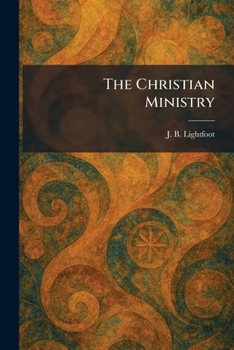
The Christian Ministry

"The Christian Ministry" is a scholarly and influential exploration of the historical origins and development of ecclesiastical leadership within the early Church. Authored by the esteemed biblical scholar and Bishop J.B. Lightfoot, this work provides a rigorous analysis of the primitive Christian community and the evolution of its ministry. Lightfoot examines the New Testament foundations and the testimony of the apostolic fathers to trace how the roles of bishops, presbyters, and deacons emerged and solidified in the first few centuries of the faith.
Through careful exegetical and historical inquiry, the text investigates the nature of the Christian priesthood and the organizational structures that shaped early Christianity. Lightfoot's approach is characterized by a commitment to historical accuracy and a deep understanding of the socio-religious context of the Roman Empire. This work is not only a study of specific church orders but also a reflective examination of the spiritual purpose of the ministry. "The Christian Ministry" continues to be a vital reference for scholars of theology and church history, offering enduring insights into the formation of the institutional Church and its governance.
This work has been selected by scholars as being culturally important, and is part of the knowledge base of civilization as we know it. This work was reproduced from the original artifact, and remains as true to the original work as possible. Therefore, you may see the original copyright references, library stamps (as most of these works have been housed in our most important libraries around the world), and other notations in the work.
This work is in the public domain in the United States of America, and possibly other nations. Within the United States, you may freely copy and distribute this work, as no entity (individual or corporate) has a copyright on the body of the work.
As a reproduction of a historical artifact, this work may contain missing or blurred pages, poor pictures, errant marks, etc. Scholars believe, and we concur, that this work is important enough to be preserved, reproduced, and made generally available to the public. We appreciate your support of the preservation process, and thank you for being an important part of keeping this knowledge alive and relevant.
Customer Reviews
ThriftBooks ® and the ThriftBooks ® logo are registered trademarks of Thrift Books Global, LLC
