


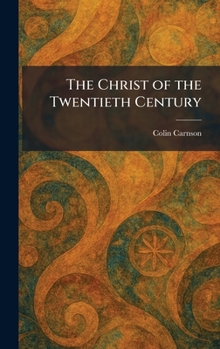
The Christ of the Twentieth Century

"The Christ of the Twentieth Century" is a compelling theological study that seeks to interpret the person and mission of Jesus Christ for a modern audience. Written during a pivotal era of social and intellectual shift, Colin Carnson examines how the fundamental principles of the Christian faith relate to the unique challenges and cultural landscape of the early twentieth century.
The work explores the intersection of eternal spiritual truths and the evolving needs of a society in transition. By focusing on a vision of Christ that is both historically grounded and dynamically relevant to contemporary life, Carnson addresses the quest for spiritual meaning in an age of rapid change. The text provides a thoughtful analysis of Christ's teachings, emphasizing their enduring power to guide and inspire the individual soul amidst the complexities of modern existence.
Ideal for scholars of religious history and students of modern theology, "The Christ of the Twentieth Century" offers a window into the evolving Christological discourse of its time. It serves as an important record of the effort to harmonize traditional doctrine with the modern experience, reflecting a profound commitment to making the message of the Gospel accessible and vital for a new generation of believers.
This work has been selected by scholars as being culturally important, and is part of the knowledge base of civilization as we know it. This work was reproduced from the original artifact, and remains as true to the original work as possible. Therefore, you may see the original copyright references, library stamps (as most of these works have been housed in our most important libraries around the world), and other notations in the work.
This work is in the public domain in the United States of America, and possibly other nations. Within the United States, you may freely copy and distribute this work, as no entity (individual or corporate) has a copyright on the body of the work.
As a reproduction of a historical artifact, this work may contain missing or blurred pages, poor pictures, errant marks, etc. Scholars believe, and we concur, that this work is important enough to be preserved, reproduced, and made generally available to the public. We appreciate your support of the preservation process, and thank you for being an important part of keeping this knowledge alive and relevant.
Customer Reviews
ThriftBooks ® and the ThriftBooks ® logo are registered trademarks of Thrift Books Global, LLC
