


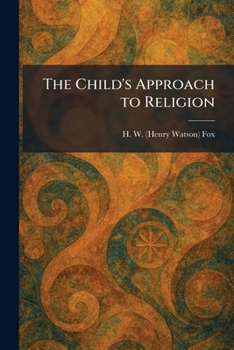
The Child's Approach to Religion

Select Format
Select Condition 
Book Overview
"The Child's Approach to Religion" by H. W. Fox is an insightful guide designed for parents and educators seeking to nurture the spiritual lives of children. Written during a transformative era in religious education, this work emphasizes a psychological and child-centered approach to faith. Fox moves away from traditional, often abstract methods of theological instruction, instead advocating for a perspective that respects the child's own imaginative and intuitive capacities.
Throughout the book, the author addresses the fundamental challenges of introducing religious concepts to young minds. He explores how to answer difficult questions about God, prayer, and morality in a way that is both honest and age-appropriate. By focusing on the development of a child's character and their natural sense of wonder, Fox provides a framework for fostering a sincere and lasting connection to spiritual values. "The Child's Approach to Religion" remains a significant historical text for those interested in the evolution of Christian pedagogy and the delicate balance of guidance and freedom in a child's religious upbringing.
This work has been selected by scholars as being culturally important, and is part of the knowledge base of civilization as we know it. This work was reproduced from the original artifact, and remains as true to the original work as possible. Therefore, you may see the original copyright references, library stamps (as most of these works have been housed in our most important libraries around the world), and other notations in the work.
This work is in the public domain in the United States of America, and possibly other nations. Within the United States, you may freely copy and distribute this work, as no entity (individual or corporate) has a copyright on the body of the work.
As a reproduction of a historical artifact, this work may contain missing or blurred pages, poor pictures, errant marks, etc. Scholars believe, and we concur, that this work is important enough to be preserved, reproduced, and made generally available to the public. We appreciate your support of the preservation process, and thank you for being an important part of keeping this knowledge alive and relevant.
Customer Reviews
ThriftBooks ® and the ThriftBooks ® logo are registered trademarks of Thrift Books Global, LLC
