


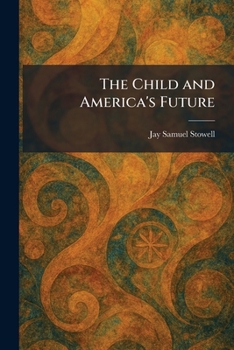
The Child and America's Future

Select Format
Select Condition 
Book Overview
"The Child and America's Future" is a compelling examination of the intersection between social welfare and Christian responsibility in the early twentieth century. This work serves as a call to action for religious and social leaders to recognize that the strength of the nation is intrinsically linked to the well-being and moral development of its children. The book explores various aspects of childhood, including physical health, educational opportunities, and the importance of recreation, all framed within a context of spiritual guidance and community duty.
Jay S. Stowell emphasizes the critical role of the church and home missions in fostering an environment where every child can thrive. By addressing then-contemporary challenges such as child labor, inadequate schooling, and spiritual neglect, the text provides a historical roadmap for how missionary education sought to influence the trajectory of American life. As a significant document of its era, "The Child and America's Future" offers valuable insight into the progressive movements of the 1920s and the evolving philosophy of child-centered social reform. It remains an essential study for those interested in the history of education, religious outreach, and the social foundations of the United States.
This work has been selected by scholars as being culturally important, and is part of the knowledge base of civilization as we know it. This work was reproduced from the original artifact, and remains as true to the original work as possible. Therefore, you may see the original copyright references, library stamps (as most of these works have been housed in our most important libraries around the world), and other notations in the work.
This work is in the public domain in the United States of America, and possibly other nations. Within the United States, you may freely copy and distribute this work, as no entity (individual or corporate) has a copyright on the body of the work.
As a reproduction of a historical artifact, this work may contain missing or blurred pages, poor pictures, errant marks, etc. Scholars believe, and we concur, that this work is important enough to be preserved, reproduced, and made generally available to the public. We appreciate your support of the preservation process, and thank you for being an important part of keeping this knowledge alive and relevant.
Customer Reviews
ThriftBooks ® and the ThriftBooks ® logo are registered trademarks of Thrift Books Global, LLC
