


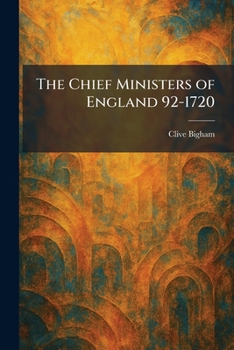
The Chief Ministers of England 92-1720

Select Format
Select Condition 
Book Overview
"The Chief Ministers of England 92-1720" provides a comprehensive historical survey of the men who stood at the right hand of the English monarchy for eight centuries. This scholarly yet accessible work traces the evolution of political power in England from the early medieval period through the complex dynastic shifts of the Plantagenets, Tudors, and Stuarts, concluding with the rise of the early modern administrative system in the 18th century.
The volume offers detailed biographical sketches of the realm's most influential figures, examining their lives, administrative achievements, and the political environments in which they operated. By exploring the careers of these chief ministers, the narrative illustrates the shifting relationship between the Crown and its most powerful servants. From the advisors of Saxon kings to the architects of the early Hanoverian state, these individuals navigated the treacherous waters of court intrigue, religious reform, and constitutional change.
Rich in historical insight, "The Chief Ministers of England 92-1720" is an essential resource for those interested in the development of the English state. It provides a unique lens through which to view the growth of governance and the enduring legacy of the individuals who shaped the course of British history.
This work has been selected by scholars as being culturally important, and is part of the knowledge base of civilization as we know it. This work was reproduced from the original artifact, and remains as true to the original work as possible. Therefore, you may see the original copyright references, library stamps (as most of these works have been housed in our most important libraries around the world), and other notations in the work.
This work is in the public domain in the United States of America, and possibly other nations. Within the United States, you may freely copy and distribute this work, as no entity (individual or corporate) has a copyright on the body of the work.
As a reproduction of a historical artifact, this work may contain missing or blurred pages, poor pictures, errant marks, etc. Scholars believe, and we concur, that this work is important enough to be preserved, reproduced, and made generally available to the public. We appreciate your support of the preservation process, and thank you for being an important part of keeping this knowledge alive and relevant.
Customer Reviews
ThriftBooks ® and the ThriftBooks ® logo are registered trademarks of Thrift Books Global, LLC
