


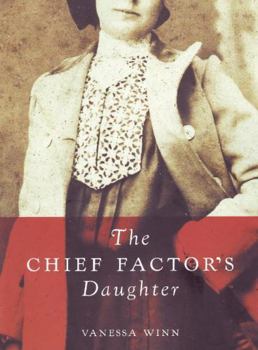
The Chief Factor's Daughter


Chief factor: In the Hudson's Bay Company fur-trade monopoly, the title of chief factor was the highest rank given to commissioned officers, who were responsible for a major trading post and its... This description may be from another edition of this product.
Format:Paperback
Language:English
ISBN:1894898931
ISBN13:9781894898935
Release Date:February 2010
Publisher:TouchWood Editions
Length:288 Pages
Weight:0.75 lbs.
Dimensions:0.8" x 5.4" x 7.4"
Customer Reviews
1 rating
Oldest unmarried daughter, living at home
Published by Thriftbooks.com User , 16 years ago
In 1670, King Charles II of England granted a commercial charter for exclusive fur trade in British North America to The Governor and Company of Adventurers of England trading into Hudson's Bay. For centuries HBC--the Hudson's Bay Company--were the defacto government over a huge area of what is now most of Canada and a small section of the northern United States. Hudson Bay forts, the only European settlements in a vastly un-colonized land, existed for one purpose: to buy and ship furs. A factor (agent)--often the only European for hundreds of miles--ran each fort. In remote areas like the Scottish Hebrides an impoverished, unmarried man had two choices: starve to death at home or become a Hudson's Bay factor. After a lifetime of difficult work in remote areas, a few of these men rose to the position of Chief Factor, the man responsible for a major trading post and their surrounding district. They married First Nations or Metis women, built large houses, were given permission to retain a cook and a steward at Company expense, and became socially prominent in the communities that eventually sprung up around the forts. In 1859, Oregon became a state. That put the border of the United States right across the Columbia River from the headquarters of the HBC's pacific region. The Company moved their pacific headquarters to Fort Victoria, today the site of the city of Victoria, capital of British Columbia. It was an unsettled time in Fort Victoria. The town had already expanded far beyond the confines of the original Company fort. Long-time HBC employees, like Chief Factor John Work, could recall a time when he knew every person who attended a dance, wedding, or funeral. But no more. The town is flooded with people: gold miners on their way to the Fraser River strike; American entrepreneurs, who view Victoria as an extension of their country; competing First Nations people, camping too close to town for some people's liking; and transplanted Englishmen, who consider being in charge their natural birthright, and who bring with them class and race prejudices. Margaret Work is John Work's "oldest unmarried daughter, living at home." A spinster at 23, she knows that her prospects for marriage aren't good. Of all the Work girls, she's the only one who inherited her Metis's mother's dark hair and skin. As if being (incorrectly) referred to as a half-breed wasn't bad enough, Margaret grew up in the isolated fort where her father was Chief Factor. She thinks nothing of taking walks unchaperoned, usually the only time she can be by herself. She can ride a horse beautifully and has never heard of a side-saddle. She reads, not only novels, but newspapers. Still, because the ratio of young women to young men is abysmally skewed toward the men, and because John Work is respected by the remaining HBC community, she's included in dances and parties. Good to have another dance card to fill, but would you really want your son to marry her? This is a novel of mar
Copyright © 2026 Thriftbooks.com
Terms of Use | Privacy Policy | Do Not Sell/Share My Personal Information | Cookie Policy | Cookie Preferences | Accessibility Statement
ThriftBooks ® and the ThriftBooks ® logo are registered trademarks of Thrift Books Global, LLC
ThriftBooks ® and the ThriftBooks ® logo are registered trademarks of Thrift Books Global, LLC
