


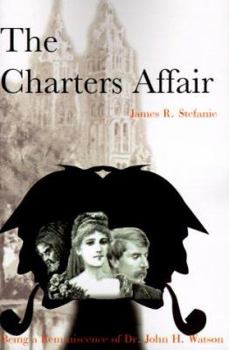
The Charters Affair: Being a Reminiscence of Dr. John H. Watson


In 1537, the Abbot Jervais Guillaume de Forrestier disappeared along with the treasures of an abbey. Over 300 years later, explorers at a neolithic site discovered the body of their expedition leader.... This description may be from another edition of this product.
Format:Paperback
Language:English
ISBN:0595099262
ISBN13:9780595099269
Release Date:July 2000
Publisher:iUniverse
Length:430 Pages
Weight:1.49 lbs.
Dimensions:1.1" x 6.0" x 9.0"
Related Subjects
Fiction Historical Literature & Fiction Mystery Mystery, Thriller & Suspense Suspense ThrillersCustomer Reviews
5 ratings
Holmes as Archeologist
Published by Thriftbooks.com User , 24 years ago
Worn out from a recent excess of cases, Holmes and Watson are taking it easy when a telegram reaches them from Inspector MacDonald, a man Holmes greatly respects. It seems that Professor Josiah Addleton, an eminent historian, had been killed under grotesque circumstances at the village of Little Stoke in the Vale of the Bittern.Rushing off to the village, Holmes and Watson discover that Addleton had been excavating a barrow near the village. In addition to the prehistoric contents of the barrow, the Professor was also on a quest to discover treasure stolen four centuries before from a local monastery. In addition there are two equally ancient royal charters. These charters were needed to resolve a long standing argument over land holdings between two prominent local families - The Grey's and the Forrester's. Something the Professor knew triggered his murder, but what is a mystery.Watson investigates the village, talking to the people and accumulating lore about local legends and myths. Children's rhymes and old men's tales. Little Stoke was the site of a colorful 16th century history, from smugglers to knights, as well as a rich prehistory full of barrows and cairns. Holmes, on the other hand, focuses on the chief players. Rowland Forrester, and William and Mary Grey are the opponents in the argument over land rights. Professor Frey and Portland Donner, were Addleton's partners at the dig. There are many others whose roles are less clear, but whose part in the mystery is undoubted. Holmes and Watson uncover layer after layer of mystery and deception as they seek the murderer, the missing treasure and documents.The tale itself is mystifying and entertaining. I found myself immersed in each of the several stories that unravel under Holmes' piecing eye. There is something here for everyone, from horseracing to archeology, and the pictures of rural England make it a 19th century travelogue as well. Only a few qualms have kept me from giving the novel a 5 star rating.The first is the writing style. Since none of Doyle's stories really classify as full blown novels, writers who venture into this territory must create a believable Watsonian style for themselves. In James Stefanie's case he had adopted some of the approaches that Doyle uses elsewhere, and backfilled with his own invention. Unfortunately, while the writing is good, it does not always ring true to Watson, showing much more attention to local color and far more philosophical brooding than Doyle's Watson ever demonstrated.
Dr. Watson, I presume?
Published by Thriftbooks.com User , 24 years ago
Throughout the first hundred pages of "The Charters Affair" you might ask yourself why James Stefanie included so much detail and description. If you did and continued to read until the plot took over, the answer became self-evident: familiarity. You gain a such feel for the area and its inhabitants that you almost become one of the people sitting in the parlor as Holmes unveils the perpetrator at the end of the story. For a first-time reader of the Holmes genre, like myself, the Charters Affair included just the right amount of background and reminiscence to answer some of my questions concerning the relationship between Sherlock Holmes and Dr. Watson. It also allowed me to see the two men as separate and distinct personalities. Holmes with his systematic, unidirectional, unbending, and often Machiavellian drive contrasted starkly with Watson's thoughtful, sometimes muddling, optimistic and occasionally flustered, all too human view of life. Seeing Holmes through Watson's eyes, with a doctor's concern for the physical wellbeing of a friend, was illuminating, and added depth to the narrator. And as the story is a reminiscence, the author's use of somewhat antiquated language worked well. My studies in England acquainted me with the style and verbiage employed by Mr. Stefanie in telling this story, and for me enhanced the experience markedly. Without giving away the plot, the tale is a complex interwoven fabric of many eras, including a tribal burial in pre-Druid times, the monastic middle ages, the granting and misplacing of land charters, the pirate trade, and a Holmesian-era expedition to excavate the tor that brings Holmes and Watson to the area to solve a murder mystery. All in all, great intellectual fun with twists and turns, a complex plot, and very interesting characters. I had the good fortune to tip a pint or two with James Stefanie shortly after his novel was published, and after our conversation wondered not whether Sherlock Holmes had actually lived, but whether Dr. Watson had ever actually died.
Conan Doyle Lives Again
Published by Thriftbooks.com User , 24 years ago
I have read and re-read the Sherlock Holmes mysteries over and over for the past 60+ years. Mr. Stefanie has captured the essence and being of both Holmes, and Watson - a feat yet to be accomplished by writers of Holmesian stories in this day and age.The description of places and people in this book are without equal. If you've never been to England, you will upon reading this book, immediately want to pack your bags and seek out these bucolic villages and quaint places. If you've already been to England, the nostalgia will be overwhelming. His vivid descriptions paint a picture of Holmes' Victorian England that will send the reader back in time. Here is a writer who may be an alter-ego of Sherlock Holmes, or a reincarnation of Conan Doyle. This book is a "keeper" - to be read, and re-read, each time with the expectation of once more meeting the great Sherlock Holmes and his side-kick the erstwhile Dr. Watson ala Conan Doyle.
the charters affair
Published by Thriftbooks.com User , 24 years ago
I have been reading Sir Arthur Conan Doyle books for over 20 years. I have returned again and again because I enjoy the intrigue, Holme's arrogance, Watson's loyalty and the entre each books allows into English custom, culture and countryside. I especially enjoyed The Charters Affair for all those things and most especially for the piece of history it unfolds for the reader regarding the church, landowners, rulers and the myth and mystique that swirls around the hills and barrows for generations to come. The views are dramatic, the dampness will chill your bones and the truth peels like an onion in search of justice.
The Holmes Novel Doyle Never Wrote
Published by Thriftbooks.com User , 24 years ago
Sir Arthur Conan Doyle's immortal creation, Sherlock Holmes, 'lives' in 56 short stories and four 'novella' length adventures. Doyle never wrote a novel-length adventure based on his creation; the total output of his genius was directed to audiences who read periodicals, such as 'The Strand'. Regardless of how intricate a plot could be, the resolution was accomplished in a modicum of words. Limited by the requirements of periodical publishing, and interested more in grand historical novels, Doyle never pursued a true Sherlock Holmes novel.'The Charters Affair' remedies this situation. It is 'The Holmes Novel Doyle Never Wrote', an inspired blend of Doyle's creation with Doyle's passion for history. Although there have been numerous novel-length adventures of Sherlock Holmes, such as the series by Frank Thomas and the novels by Nicholas Myers, few have attempted to take on the task of writing a Victorian novel with Holmes as the centerpiece.'The Charters Affair' is based on a Watsonian reference (in the Adventure of the Golden Pince-Nez) to an untold Holmesian tale. The author starts from this one line and unfurls a tale stretching from the predawn of history to the murder of an scientist at an archeological dig. Set in the south of England, the story is both evocative in its descriptions of both place and person. The author has made every effort to maintain the Watsonian writing style and has generally succeeded in the attempt. (While it is usual to review any Holmes book with an eye to comparing it to Watson's writing style, most Sherlockian scholars would agree that even Watson wasn't consistent! There are even cases of `Americanisms' slipping into adventures from the `Casebook'),While Holmes and Watson work their way through one, then another, mystery, it becomes clear that the author has also shifted focus from Holmes to Watson during the crucial periods of investigation. This change of focus does three important things - it represents Watson's intelligence and industry in a better light than most of the earlier Holmes adventure; it uncovers the necessary hard work and diligence Holmes applied to solving a case; and finally represents Holmes - not as a magician - but as an astute observer who has well-trained himself to think logically. Too often we conceive of Holmes stultifying an amazed, and slow-thinking, Watson with an act of mental legerdemain - solving baffling crimes by barely stretching from his easy chair. Although Watson does relate a few instances where Holmes solved a client's case with the merest expression of physical activity, Watson also often tells us with what effort Holmes expended in cases after case, often leaving their humble chambers at 221b Baker Street for days at a time. The restrictions of short story writing forced Doyle into compressing all the neat `behind the scenes' activities Holmes undertook in his pursuit of the truth and book ending them with the classic Holmes/Watson openings and the magical resolution at
Copyright © 2026 Thriftbooks.com Terms of Use
| Privacy Policy | Do Not
Sell/Share My Personal Information | Cookie Policy | Cookie Preferences | Accessibility Statement
ThriftBooks® and the ThriftBooks® logo are registered trademarks of Thrift Books Global, LLC
ThriftBooks® and the ThriftBooks® logo are registered trademarks of Thrift Books Global, LLC
