


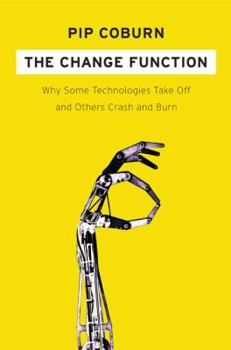
The Change Function: Why Some Technologies Take Off and Others Crash and Burn

Select Format
Select Condition 
Book Overview
After years of studying countless winners and losers, Coburn has come up with a simple idea that explains why some technologies have become huge hits (iPods, DVD players), but others have never reached more than a tiny audience (Segways, tablet PCs). This book argues that people are only willing to change when the pain of their current situation outweighs the perceived pain of trying something new. In other words, technology demands a change in habits. The Change Function is an irrevent, but highly insightful look at how this pattern plays out in countless sectors.
Format:Hardcover
Language:English
ISBN:1591841321
ISBN13:9781591841326
Release Date:June 2006
Publisher:Portfolio Hardcover
Length:240 Pages
Weight:0.95 lbs.
Dimensions:9.2" x 0.9" x 6.3"
Age Range:18 years and up
Grade Range:Grade 12 and higher
Related Subjects
Business Business & Finance Business & Investing Business & Management Communications Computers & Technology Education & Reference Engineering Industrial, Manufacturing & Operational Systems Industries & Professions Manager's Guides to Computing Science & Math Skills Software Technology TextbooksCustomer Reviews
5 ratings
Essential requirements for high-tech product success
Published by Thriftbooks.com User , 19 years ago
Intel icons Gordon Moore and Andy Grove are each credited with a high-tech development axiom. "Moore's Law" says the cost of putting the maximum number of transistors on an integrated circuit (like a computer chip) doubles every 24 months. This leads to the "price elasticity argument" that infers the ideal price at which consumers will find new high-tech products attractive. "Grove's Law" posits that people adopt new technology when it is "disruptive," that is, when it becomes 10 times better than anything else available. But author Pip Coburn, who writes with a lively pen, believes that high-tech leaders must put these revered principles aside, and focus instead on the people who use their technological marvels. Those who appeal to consumers will thrive. Those who do not will lose money as their products go down in flames. Is Coburn correct? As the founder of a firm that advises investors on high-tech stocks, he makes a compelling argument. We suggest that technology executives, portfolio managers, and anyone else concerned with the success of high-tech companies and their products will want to read this thoughtful book before placing their own bets.
A Refreshing and Unique Look at Change
Published by Thriftbooks.com User , 19 years ago
Finally! A unique and refreshing view of change; and it is penned by a former technology securities analyst. Who would have thought it? Pip Coburn, who runs his own advisory firm and former managing director and global technology strategist, looks at his industries through the view finder of the consumer. And he does it in a lively style that delivers sharp insights into why a few technologies soar; while most fall flat on their faces. It is simple. Yet, like many simple ideas it captures the essence of change. Ready? People are only willing to change and accept new technologies when the pain of their current situation outweighs the perceived pain of trying something new. Quoting everyone from Machiavelli to Yoda, Coburn topples clichés about innovation and change spouted for years by overpaid gurus and the equally overpaid CEOs who employ them. In only takes a few pages of reading before you can answer questions that have been plaguing you for years, like: * Why do you have so many passwords? * Why your VCR flashes 12:00? * Why your spell check Capitalizes words you Do not want capitalized? * Who thinks a smart phone is smart? * Who asked for interactive TV? Pip Coburn is a keen observer. He views his field from a unique vantage point. Time spent with this book will give you new understanding of technology. Linger over its message for a while; you will become a wiser investor, manager, CEO or computer geek.
Doesn't stop at problem analysis, but can go even further!
Published by Thriftbooks.com User , 19 years ago
What a catch phrase!! "Total Percieved Pain of Adoption", TPPA. But, what is it? What does it mean? Pip Coburn wrote a book on technologies: The Change Function, Why Some Technologies Take Off and Others Crash and Burn. With his years of practice at understanding change as a 'change analyst' he tries to make us understand what is wrong with technology companies. He repeates one single message until you understand: The Change Function. The change function is what it is all about. Understanding change, because every adoption requires change. And to change is allways a free choice of an individual. In technology (companies) it's all about technology, not about the end user. An end users is an abstract entity that buys technology because it's better. (This sounds familiar.) It's about natural disruptive technologies (Grove's Law) and ever decreasing price (Moore's Law) that make it all just happen. But it doesn't just 'happen'. According to Pip only 5% of the products (read technology) developed are successfull. Unsuccessfull examples he examines are Segway, Interactive TV, The Picture Phone, ISDN and others. Successfull examples he disects are Salesforce.com and Reactrix. He even goes so far to predict the rise of Flatpanel displays (not really a surprise) and Business Intelligence software (a surprise but one long in the making), and the fall of WiMax (interesting) and RFID (in dutch we would say "vloeken in de kerk", cursing in church). His analysis is clear, concise and logical but more important it makes you understand what it is really all about: The Change Function. But the crux of the analysis is only to be found at the far end of his book, pages 204 and 205 to be precise. You will have to read the book to fully understand this message. But it is so powerfull than it can easily be turned around. Why do 'non-technology' have so much trouble innovating with, or around, emerging technologies like the web? Please, Pip, enlighten us again with you insights! But from the perspective of the struggles of 'non-technology' companies to innovate in this rapidly changing world!!!
A book that transcends its title
Published by Thriftbooks.com User , 19 years ago
Don't let the title fool you: this is a book all who persuade for a living need to read and embrace. The Big Idea: it's not the service that matters but whether the customer or client is ready to adopt what you're selling. The status quo bias will prevail until a crisis driven client needs the service you are selling and the pain of adoption is lowered to the point where the bias does not block the change. A simple but elegant idea that he talks about with lots of examples.The last three chapters help you integrate his ideas with a case study, questions to ask to see if someone is customer centric or self centered, and a To Do list to become the first and not the second. The writing is direct("earthlings do not want to learn, nor do they enjoy learning"), peppered with interesting quotes and charts, and ends at 213 pages. Let me stress the 213---so many books are really fattened up articles, and this one is not. As Coburn might say, the crisis of not knowing his message is high(we need to know why people do what they do), and the perceived pain of adoption is low(a weeekend spent reading the book).
Very useful for understanding technology and the general subject of change
Published by Thriftbooks.com User , 19 years ago
Pip Coburn has done an exceptional job crystallizing the subject of change into a simple yet powerful framework that has numerous implications. Investors, inventors, entrepreneurs, managers, consultants and others would benefit from using this framework as a reality check and source of idea inspiration while assessing the potential for new products and services. The book's ideas are not limited to technology. In one colorful example, an intelligent woman applies the change function's "perceived pain of adoption" concept to understanding why men were suddenly very interested in diets a few years ago. What had brought about the change? At the time, low-carb diets were allowing men to eschew salads and other unfulfilling diet foods in favor hearty, protein-laden meals. As a result, the perceived difficulty of dieting had been lowered, and the number of individuals willing to try diets exploded. A fantastic book for anyone interested in technology and/or the general topic of change.
Copyright © 2026 Thriftbooks.com
Terms of Use | Privacy Policy | Do Not Sell/Share My Personal Information | Cookie Policy | Cookie Preferences | Accessibility Statement
ThriftBooks ® and the ThriftBooks ® logo are registered trademarks of Thrift Books Global, LLC
ThriftBooks ® and the ThriftBooks ® logo are registered trademarks of Thrift Books Global, LLC
