


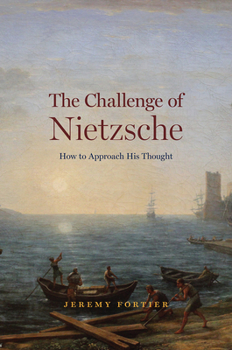
The Challenge of Nietzsche: How to Approach His Thought
No Customer Reviews

Friedrich Nietzsche has been one of the most widely read authors in the world from the time of his death to the present day, as well as one of the most controversial. He has been celebrated as a liberating theorist of individual creativity and self-care, but also condemned as the inhumane advocate of anti-modern politics and hierarchical communalism. Jeremy Fortier contends that rather than adopting one of these approaches to Nietzsche's thought at the expense of the other, we ought instead to understand Nietzsche's complex legacy as the consequence of a self-conscious and artful tension woven into the fabric of his books.
The Challenge of Nietzsche uses Nietzsche as a guide to Nietzsche, highlighting the fact that Nietzsche equipped his writings with retrospective self-commentaries and an autobiographical apparatus that clarify how he understood his development as an author, thinker, and human being. Fortier shows that Nietzsche used his writings to establish two major character-types, the Free Spirit and Zarathustra, who represent two different approaches to the conduct and understanding of life: one that strives to be as independent and critical of the world as possible, and one that engages with, cares for, and aims to change the world. Nietzsche developed these characters at different moments of his life, in order to confront from contrasting perspectives such elemental experiences as the drive to independence, the feeling of love, and the assessment of one's overall health (or well-being). Understanding the tension between the Free Spirit and Zarathustra takes readers to the heart of what Nietzsche identified as the tensions central to his life, and to all human life.
The Challenge of Nietzsche uses Nietzsche as a guide to Nietzsche, highlighting the fact that Nietzsche equipped his writings with retrospective self-commentaries and an autobiographical apparatus that clarify how he understood his development as an author, thinker, and human being. Fortier shows that Nietzsche used his writings to establish two major character-types, the Free Spirit and Zarathustra, who represent two different approaches to the conduct and understanding of life: one that strives to be as independent and critical of the world as possible, and one that engages with, cares for, and aims to change the world. Nietzsche developed these characters at different moments of his life, in order to confront from contrasting perspectives such elemental experiences as the drive to independence, the feeling of love, and the assessment of one's overall health (or well-being). Understanding the tension between the Free Spirit and Zarathustra takes readers to the heart of what Nietzsche identified as the tensions central to his life, and to all human life.
Format:Hardcover
Language:English
ISBN:022667939X
ISBN13:9780226679396
Release Date:March 2020
Publisher:University of Chicago Press
Length:256 Pages
Weight:1.05 lbs.
Dimensions:1.0" x 6.0" x 9.1"
Customer Reviews
0 rating
Copyright © 2026 Thriftbooks.com Terms of Use
| Privacy Policy | Do Not
Sell/Share My Personal Information | Cookie Policy | Cookie Preferences | Accessibility Statement
ThriftBooks® and the ThriftBooks® logo are registered trademarks of Thrift Books Global, LLC
ThriftBooks® and the ThriftBooks® logo are registered trademarks of Thrift Books Global, LLC
