


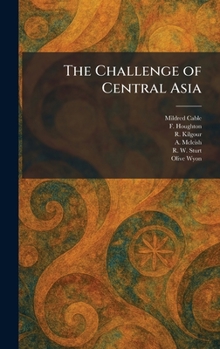
The Challenge of Central Asia

"The Challenge of Central Asia" provides a comprehensive survey of the vast, complex territories of Central Asia during the early 20th century. Authored by a distinguished group of travelers and observers, including the renowned explorer Mildred Cable, this work examines the social, political, and spiritual landscape of regions such as Tibet, Sinkiang, and Mongolia. It explores the diverse cultures and geographical hurdles of the "dead heart of Asia," detailing the historical challenges faced by those seeking to bridge cultural and religious divides in some of the world's most remote locations.
The text combines firsthand observations with socio-religious analysis, offering insights into the impact of shifting political boundaries and the enduring traditions of the indigenous populations. "The Challenge of Central Asia" serves as an important historical document, capturing a pivotal moment of transition for the region and highlighting the intersection of Western missionary interest with the intricate geopolitics of the East. Readers will find a detailed account of the demographic challenges and the spiritual aspirations that defined the area during this era of exploration.
This work has been selected by scholars as being culturally important, and is part of the knowledge base of civilization as we know it. This work was reproduced from the original artifact, and remains as true to the original work as possible. Therefore, you may see the original copyright references, library stamps (as most of these works have been housed in our most important libraries around the world), and other notations in the work.
This work is in the public domain in the United States of America, and possibly other nations. Within the United States, you may freely copy and distribute this work, as no entity (individual or corporate) has a copyright on the body of the work.
As a reproduction of a historical artifact, this work may contain missing or blurred pages, poor pictures, errant marks, etc. Scholars believe, and we concur, that this work is important enough to be preserved, reproduced, and made generally available to the public. We appreciate your support of the preservation process, and thank you for being an important part of keeping this knowledge alive and relevant.
Customer Reviews
ThriftBooks ® and the ThriftBooks ® logo are registered trademarks of Thrift Books Global, LLC
