


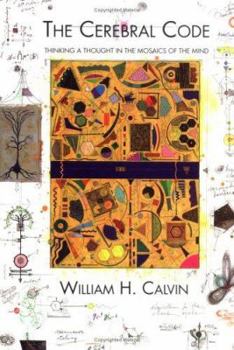
The Cerebral Code: Thinking a Thought in the Mosaics of the Mind

Select Format
Select Condition 
Book Overview
The Cerebral Code is a new understanding of how Darwinian processes could operate in the brain to shape mental images in only seconds, starting with shuffled memories no better than the jumble of our nighttime dreams, but evolving into something of quality, such as a sentence to speak aloud. Jung said that dreaming goes on continuously but you can't see it when you are awake, just as you can't see the stars in the daylight because it is too bright. Calvin's is a theory for what goes on, hidden from view by the glare of waking mental operations, that produces our peculiarly human type of consciousness with its versatile intelligence. As Piaget emphasized in 1929, intelligence is what we use when we don't know what to do, when we have to grope rather than using a standard response. Calvin tackles a mechanism for doing this exploration and improvement offline, as we think before we act or practice the art of good guessing. Surprisingly, the subtitle's mosaics of the mind is not a literary metaphor. For the first time, it is a description of a mechanism of what appears to be an appropriate level of explanation for many mental phenomena, that of hexagonal mosaics of electrical activity that compete for territory in the association cortex of the brain. This two-dimensional mosaic is predicted to grow and dissolve much as the sugar crystals do in the bottom of a supersaturated glass of iced tea. A Bradford Book
Format:Hardcover
Language:English
ISBN:0262032414
ISBN13:9780262032414
Release Date:August 1996
Publisher:Bradford Books
Length:264 Pages
Weight:1.00 lbs.
Dimensions:9.5" x 1.0" x 6.3"
Customer Reviews
4 ratings
Possibly an important step in explaining thought
Published by Thriftbooks.com User , 22 years ago
Most attempts to describe how thought works either start at a very low level (such as a single neuron) and have trouble scaling up to anything complex, or start at an abstract level (e.g. Minsky's Society of Mind) that don't come close to the level of detail needed for computer simulations of a working mind.This book is the best attempt I've seen to bridge that gap. It is almost detailed enough to suggest how the patterns involved could be built out of individual neurons, while providing ideas about how to create complex patterns.It still isn't specific enough to create a simulation that would produce anything resembling human thought, but I can imagine that Calvin's theory will prove to be one of the bigger steps needed to create such a simulation.
My review of "The Celebral Code".
Published by Thriftbooks.com User , 24 years ago
Calvin surprised me in this book. I am the kind of guy interested in intelligence, how it might work biologically, and lastly I was given an advice by a fellow at bionet.neuroscience.The book gave me food for thought, and even as I am studying neurology in much more detail; "Principles of Neural Science" by Kandel et al; the basic idea that Calvin lay down in written form is still influencing me.But if you really want the best usage of this book, you at least have to know SOME basics (which I didn't have to much of), and read the book when you know what corticothalamic pathways mean. 5 stars for the book, well deserved.This applies also for "How Brains Think" which was written before the "The Celebral Code".I urge you to get both books, read first "How Brains Think", and then "The Celebral Code".
He may be right
Published by Thriftbooks.com User , 28 years ago
I've been away from neurophysiology and cognitive psychology for a decade, and I picked this book up to see what kinds of ideas had gained currancy since my academic days. So far, I'm pretty impressed with Calvin. He may not be right- he may not even be close, for that matter. And he's still a bit weak on the transition from biology to conciousness. But it's well thought out, well developed, and certainly well worth reading for anyone interested in how biology connects with conciousness.
William Calvin deserves a Nobel Prize.
Published by Thriftbooks.com User , 29 years ago
These are incredible results from incredible research. From the look of some other reviews, it is apparent that some people are so amazed at the contents of this book that their own cognitive dissonance prevents them from believing that Dr. Calvin's results, and the resulting explanations, are real: They mutter that people shouldn't be allowed to go on speculating so.William Calvin's findings appear to fill in the missing pieces connecting both ends of the model of brain function -- which for decades has being built from the bottom up by neuroscientists, and from the top down by artificial intelligence researchers. This is nothing short of miraculous; I didn't think I would live to see this in my lifetime!If Dr. Calvin doesn't receive a Nobel prize for this work, the selection committee just isn't doing their homework. --Sherwin Gooc
Copyright © 2026 Thriftbooks.com
Terms of Use | Privacy Policy | Do Not Sell/Share My Personal Information | Cookie Notice | Cookie Preferences | Accessibility Statement
ThriftBooks ® and the ThriftBooks ® logo are registered trademarks of Thrift Books Global, LLC
ThriftBooks ® and the ThriftBooks ® logo are registered trademarks of Thrift Books Global, LLC
