


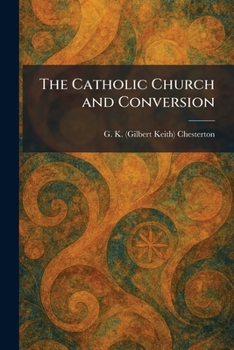
The Catholic Church and Conversion

Select Format
Select Condition 
Book Overview
"The Catholic Church and Conversion" is an insightful and personal exploration of the spiritual journey into the Catholic faith by one of the twentieth century's most celebrated thinkers, G. K. Chesterton. In this classic work of Christian apologetics, Chesterton examines the intellectual and emotional processes involved in religious conversion, addressing the common misconceptions and hurdles that often stand in the way of those seeking the "Church of the Ages."
Drawing on his own experiences and his signature wit, Chesterton describes the various stages of the convert's path, from initial curiosity to final acceptance. He presents the Catholic Church not as a restrictive institution, but as a liberating force that offers a coherent and profound understanding of the human condition. Through a series of brilliant essays, the author argues that conversion is not a loss of liberty, but a discovery of objective truth and historical continuity.
This work remains a vital text for anyone interested in theology, religious history, or the personal philosophy of Chesterton himself. It provides a timeless defense of faith and a compelling look at the motivations behind one of the most famous literary conversions in history.
This work has been selected by scholars as being culturally important, and is part of the knowledge base of civilization as we know it. This work was reproduced from the original artifact, and remains as true to the original work as possible. Therefore, you may see the original copyright references, library stamps (as most of these works have been housed in our most important libraries around the world), and other notations in the work.
This work is in the public domain in the United States of America, and possibly other nations. Within the United States, you may freely copy and distribute this work, as no entity (individual or corporate) has a copyright on the body of the work.
As a reproduction of a historical artifact, this work may contain missing or blurred pages, poor pictures, errant marks, etc. Scholars believe, and we concur, that this work is important enough to be preserved, reproduced, and made generally available to the public. We appreciate your support of the preservation process, and thank you for being an important part of keeping this knowledge alive and relevant.
Customer Reviews
ThriftBooks ® and the ThriftBooks ® logo are registered trademarks of Thrift Books Global, LLC
