


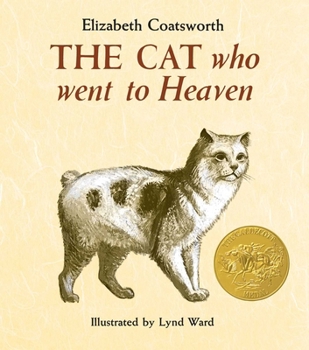
The Cat Who Went to Heaven


Select Format
Select Condition 
Book Overview
A Newberry Medal Winner This timeless fable has been a classic since its first publication in 1930, and this beautifully illustrated edition brings the magic and wonder of the tale to a new generation of readers. In ancient Japan, a struggling artist is angered when his housekeeper brings home a tiny white cat he can barely afford to feed. But when the village's head priest commissions a painting of the Buddha for a healthy sum, the artist softens toward the animal he believes has brought him luck. According to legend, the proud and haughty cat was denied the Buddha's blessing for refusing to accept his teachings and pay him homage. So when the artist, moved by compassion for his pet, includes the cat in his painting, the priest rejects the work and decrees that it must be destroyed. It seems the artist's life is ruined as well--until he is rewarded for his act of love by a Buddhist miracle.
Format:Hardcover
Language:English
ISBN:0027197107
ISBN13:9780027197105
Release Date:July 1967
Publisher:Simon & Schuster Books for Young Readers
Length:72 Pages
Weight:0.91 lbs.
Dimensions:0.5" x 8.0" x 9.1"
Age Range:8 to 12 years
Grade Range:Grades 3 to 7
Customer Reviews
4 ratings
A Book for Life
Published by Thriftbooks.com User , 22 years ago
This book has been a favorite of my family mambers since it was first published in 1930 (My mother received it for her 10th birthday). The book is an excellent primer on Buddhism, and is entertaining and inspirational.Mercy is the message presented throughout the book, and this message is complemented by the message that true goodness comes from within our hearts,not from "leaders" mandating rigid belief systems. The story is that of a little cat who helps an poor artist to achieve greatness (in his craft and in his spirit) through compassion and self-sacrifice. My siblings and I grew up with this book. I read this book (it is only about 70 pages)to my mother the night before she died, and I re-read it tonight, on the eve of my 50th birthday. Although technically a "children's book" (and a Newberry Winner), it is a book that grows with you and, in many ways, is even more meaningful when you read it as an adult.
A wonder of a book
Published by Thriftbooks.com User , 26 years ago
This was my favourite children's book (well, in a dead heat with Lewis Carroll's works) when I was a child, and it remains so to this day. It is sensitive, lyrical, and captivating. I've given it to many friends, of many ages and many cultures, and all of them have liked it. It is one book I can commend without reservation: a rare and true delight.
How a cat received the blessing of Buddha.
Published by Thriftbooks.com User , 27 years ago
This short tale, which won the 1931 Newbery Medal for best contribution to American children's literature, is about a poor artist in Japan who is commissioned to paint a picture of Buddha's death. The story teaches children a little about Buddhism and about the concept of reincarnation. The artist paints pictures of the animals coming to be blessed by Buddha. But, legend said that cats never came. The artist's cat, Good Fortune, wishes to be included in the painting. Finally, the artist relents and Good Fortune dies from joy. But the priests now no longer want the painting since it doesn't agree with legend. The next day, however, they change their minds when a "miracle" occurs. Coatsworth was well-known for her children's stories and this short story is one of the classics of children literature.
A gentle, sweet story of how animals can change our lives
Published by Thriftbooks.com User , 28 years ago
I read this book as a child and am ever so glad that my own children can enjoy it. As a cat lover I greatly appreciate the beatiful and award-winning illustrations. However, the story itself is incredibly moving. I believe the lesson I learned as a child is that animals are very important to our lives and our stewardship of them is a grave responsibility. The artist's relationship with Good Fortune changed his heart and, consequently, his life. The intolerant priest learned to forgive.
Copyright © 2026 Thriftbooks.com
Terms of Use | Privacy Policy | Do Not Sell/Share My Personal Information | Cookie Notice | Cookie Preferences | Accessibility Statement
ThriftBooks ® and the ThriftBooks ® logo are registered trademarks of Thrift Books Global, LLC
ThriftBooks ® and the ThriftBooks ® logo are registered trademarks of Thrift Books Global, LLC
