


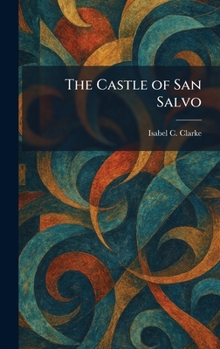
The Castle of San Salvo

In "The Castle of San Salvo," Isabel C. Clarke weaves a compelling narrative of love, faith, and the complexities of the human heart. Set against the evocative backdrop of Italy, the novel explores the lives of characters caught between personal desire and moral duty. As the story unfolds within and around the titular castle, readers are drawn into a world where the traditions of the past collide with the evolving social dynamics of the early 20th century.
Known for her expertise in crafting romantic fiction with a strong moral core, Clarke presents a cast of characters whose journeys are as much spiritual as they are emotional. The lush descriptions of the Italian landscape serve as a poignant contrast to the internal struggles of the protagonists, making the setting a vital character in its own right. "The Castle of San Salvo" stands as a testament to Clarke's ability to blend popular fiction with deeper themes of redemption and conviction, offering a window into the literary tastes of the 1920s.
This work remains a significant example of early 20th-century religious fiction, appealing to readers interested in historical romance and the enduring power of faith in literature. Clarke's prose captures the elegance and tension of an era on the brink of change, ensuring the story's place among the notable works of its genre.
This work has been selected by scholars as being culturally important, and is part of the knowledge base of civilization as we know it. This work was reproduced from the original artifact, and remains as true to the original work as possible. Therefore, you may see the original copyright references, library stamps (as most of these works have been housed in our most important libraries around the world), and other notations in the work.
This work is in the public domain in the United States of America, and possibly other nations. Within the United States, you may freely copy and distribute this work, as no entity (individual or corporate) has a copyright on the body of the work.
As a reproduction of a historical artifact, this work may contain missing or blurred pages, poor pictures, errant marks, etc. Scholars believe, and we concur, that this work is important enough to be preserved, reproduced, and made generally available to the public. We appreciate your support of the preservation process, and thank you for being an important part of keeping this knowledge alive and relevant.
Customer Reviews
ThriftBooks® and the ThriftBooks® logo are registered trademarks of Thrift Books Global, LLC
