


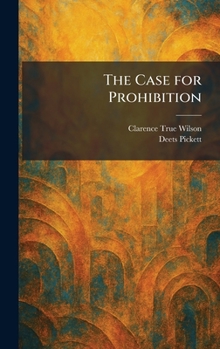
The Case for Prohibition

"The Case for Prohibition" provides a comprehensive defense of the Eighteenth Amendment and the social benefits of alcohol restriction in early twentieth-century America. Written by Clarence True Wilson and Deets Pickett, two leading figures in the temperance movement, this work outlines the moral, economic, and physical arguments for the prohibition of liquor. The authors explore the impact of alcohol on the American family, the labor force, and public health, presenting a vision of a society liberated from the perceived vices of the saloon.
This historical text serves as an essential primary source for understanding the fervor and rationale behind one of the most significant social experiments in United States history. By examining contemporary statistics and social conditions, Wilson and Pickett make a structured case for why they believed the permanent abolition of the liquor traffic was necessary for national progress. "The Case for Prohibition" remains a vital document for students of American history, sociology, and political science, offering deep insight into the ideological foundations of the Prohibition era.
This work has been selected by scholars as being culturally important, and is part of the knowledge base of civilization as we know it. This work was reproduced from the original artifact, and remains as true to the original work as possible. Therefore, you may see the original copyright references, library stamps (as most of these works have been housed in our most important libraries around the world), and other notations in the work.
This work is in the public domain in the United States of America, and possibly other nations. Within the United States, you may freely copy and distribute this work, as no entity (individual or corporate) has a copyright on the body of the work.
As a reproduction of a historical artifact, this work may contain missing or blurred pages, poor pictures, errant marks, etc. Scholars believe, and we concur, that this work is important enough to be preserved, reproduced, and made generally available to the public. We appreciate your support of the preservation process, and thank you for being an important part of keeping this knowledge alive and relevant.
Related Subjects
History Political Science Politics & Social Sciences Social Science Social SciencesCustomer Reviews
ThriftBooks ® and the ThriftBooks ® logo are registered trademarks of Thrift Books Global, LLC
