


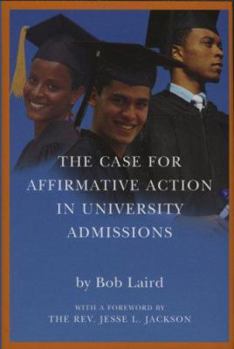
The Case for Affirmative Action in University Admissions

Explains role of affirmative action, presents the debate over these programs, and clarifies guidelines within the current law. This description may be from another edition of this product.
Format:Hardcover
Language:English
ISBN:0972002146
ISBN13:9780972002141
Release Date:August 2006
Publisher:Bay Tree Publishing
Length:304 Pages
Weight:1.35 lbs.
Dimensions:1.1" x 6.2" x 9.4"
Customer Reviews
3 ratings
A Fine Piece of Writing on an Important Subject
Published by Thriftbooks.com User , 18 years ago
In the interest of full disclosure, I should indicate that I know Bob Laird personally. He was my English teacher for the spring semester of my junior year in high school back in the late 1970s, and even though I studied with him for only a short time, I consider him among the best teachers I ever had at any level. After he left teaching to join UC Berkeley's Office of Relations with Schools, we still kept in touch and remained good friends during the past 30 years. Normally I wouldn't review a friend's book, but the reviewer below known as "Smile of Reason" (hereafter SOR) unfairly slandered Bob and gave his book a ridiculously low rating, so I felt compelled to stand up in Bob's defense. SOR claims that Bob routinely admitted unqualified minority students who had no hope of ever graduating, but this is factually wrong. In 1997, the last year of affirmative action at UC Berkeley, African-American and Latino freshmen had a 1-year retention rate of 97.1% while the white freshmen that year had a 1-year retention rate of 97.0%. Clearly the admissions office that Bob led was bringing in qualified minority candidates. SOR also claims Bob believes "... that blacks, Hispanics and Indians [sic] are intellectually inferior to whites and Asians." This, not to put too fine a point on it, is pure fantasy. I can state categorically that Bob neither said nor implied this in his book nor does he privately espouse such a foolhardy notion. To the contrary, Bob believes that minority students have just as much intellectual capacity as their non-minority counterparts, but minority students often face obstacles that any fair admissions process should take into account. SOR is simply an ideologue who distorts the facts to support his preconceived ideology. Having dispensed with SOR let me now turn to the book itself. Bob presents the history of affirmative action and explains the complex legal arguments in clear, concise expository prose accessible to non-specialists. He also has a real talent for narrative prose displayed wonderfully in chapters 6 and 7 about the anti-affirmative action directives in California (SP 1 and proposition 209) and their aftermath. Drawing upon his first hand knowledge, Bob presents lively vignettes of what transpired and interesting mini-profiles of the people involved. He not only offers penetrating insights, he also tells the story well, which one would expect from a former English teacher. I have only two criticisms of the book. First, instead of presenting statistical data in prose alone, I think he should have used tables and simply referred to those tables in the text proper. Second, I think he should have added a chapter in which he profiled half a dozen or so underprivileged minority students who had modest test scores and grade point averages because of the many hurdles they had to overcome but nevertheless succeeded fabulously at Berkeley once they were admitted. Bob's statistical analysis is impeccable, but to change some
The previous reviewer is guided by racism rather then rational
Published by Thriftbooks.com User , 19 years ago
I am all for free speech, but it is difficult to take seriously the words of people like "smile of reason" (above me), when they say things such as "this black had no chance of passing his freshman year at Cal unless there was a quota system for promotion." First of all have respect for another human being. Referring to him as "this black" is so degrading and belies true feelings towards minorities. The above reviewer' words are guided by racism and not rationale. This book is excellent and honest. I reccomend.
The Case for Honesty over Stealth Partisanship
Published by Thriftbooks.com User , 20 years ago
Bob Laird's book is important over and above the powerful case it makes for affirmative action. The book is in the best scholar-intellectual-administrator policy tradition this country has to offer: it clearly states the national goal to be achieved, a fully integrated color-blind society where color-blind means no one is penalized legally or socially on the basis of race or ethnicity; it argues that affirmative action is one of the few mechanisms that moves us toward that goal, while openly stating and addressing the societal concerns and interests that run counter to his position. In other words, Laird's book is no polemic but rather an honest and open attempt to address a national problem. The immediate challenge for those inclined against affirmative action is that you must match the level of argument presented by Laird. If you do not agree a fully integrated color-blind society is the national goal, then what is? Alternative national goals may certainly be found, but to be relevant they must still demonstrate constructive concern with the lives of those who are the subjects of the goal of an integrated color-blind society. To fail to do this is to make a kind of fraudulent stealth attack on affirmative action to no purpose other than to cause as much damage as possible, while taking no responsibility for solutions, and failing insidiously to reveal the face of the society you would have in its place. Part of what the Supreme Court does is to make sure that no matter what direction the country moves, the society face created by the change is one we would all recognise as compatible with the constitution. As Laird points out, while affirming the state's compelling interest in racial and ethnic diversity, the Supreme Court still makes certain as it did in Grutter, that other society interests are protected as well. For a university's affirmative action program to meet constitutional requirements it must conduct a full review of each applicant and compare it against all other applicants. In other words no automatic formulas or point systems will pass constitutional muster because of the likelihood other important interests could be systematically ignored thus reintroducing the kind of unfairness the whole exercise was intended to remove in the first place. Another challenge posed by the quality of Laird's argument is the use of factual information rather than rely on ignorance, racial prejudice and misinformation. Much of the legislation passed restricting or prohibiting affirmative action, especially by means of propositions as in California, depends on the existence of voters diminished in those ways. Perhaps many in California would see the prolem differently if they understood as Laird points out, that though better than 44% of public high school graduates are African American, Latino, and Native American, less than 13% were expected in 2004 to be part of the freshman class at UC Berkeley, one of California's flagship institutions. Even r
Copyright © 2026 Thriftbooks.com Terms of Use
| Privacy Policy | Do Not
Sell/Share My Personal Information | Cookie Policy | Cookie Preferences | Accessibility Statement
ThriftBooks® and the ThriftBooks® logo are registered trademarks of Thrift Books Global, LLC
ThriftBooks® and the ThriftBooks® logo are registered trademarks of Thrift Books Global, LLC
