


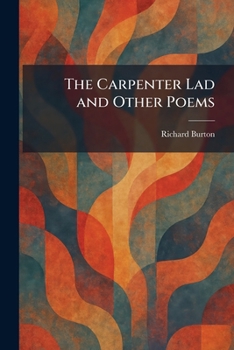
The Carpenter Lad and Other Poems

Select Format
Select Condition 
Book Overview
"The Carpenter Lad and Other Poems" is an evocative collection of verse by the distinguished American poet and literary critic Richard Burton. Capturing the essence of early 20th-century lyricism, this volume brings together a series of poems that explore themes of nature, the human spirit, and the simple yet profound moments of daily life. The title poem, "The Carpenter Lad," sets a tone of contemplative beauty, blending rhythmic grace with a deep appreciation for the craft of language.
Burton's work is characterized by its clarity of expression and emotional resonance, making this collection a significant contribution to American literature. Readers will find in these pages a mastery of traditional forms used to reflect on both the pastoral landscape and the inner workings of the soul. From quiet observations of the natural world to spirited reflections on mortality and hope, the poems offer a glimpse into the intellectual and artistic sensitivities of an era. This collection serves as a testament to Burton's legacy as a craftsman of verse, providing a rewarding experience for those who appreciate the enduring power of classic poetry.
This work has been selected by scholars as being culturally important, and is part of the knowledge base of civilization as we know it. This work was reproduced from the original artifact, and remains as true to the original work as possible. Therefore, you may see the original copyright references, library stamps (as most of these works have been housed in our most important libraries around the world), and other notations in the work.
This work is in the public domain in the United States of America, and possibly other nations. Within the United States, you may freely copy and distribute this work, as no entity (individual or corporate) has a copyright on the body of the work.
As a reproduction of a historical artifact, this work may contain missing or blurred pages, poor pictures, errant marks, etc. Scholars believe, and we concur, that this work is important enough to be preserved, reproduced, and made generally available to the public. We appreciate your support of the preservation process, and thank you for being an important part of keeping this knowledge alive and relevant.
Related Subjects
PoetryCustomer Reviews
ThriftBooks ® and the ThriftBooks ® logo are registered trademarks of Thrift Books Global, LLC
