


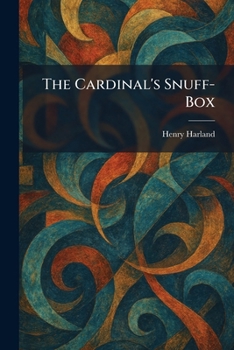
The Cardinal's Snuff-Box

"The Cardinal's Snuff-Box" is a charming and sophisticated romantic comedy set against the idyllic backdrop of the Italian countryside. The story follows Peter Marchant, an English novelist who has retreated to a villa in the Italian hills to focus on his writing. His quiet life is delightfully disrupted when he encounters the beautiful and spirited Duchess Beatrice, a young widow who happens to be his landlady. As Peter finds himself increasingly captivated by the Duchess, the narrative unfolds through a series of witty exchanges and elegant social encounters.
Central to their burgeoning relationship is the titular snuff-box, a delicate object belonging to the Duchess's uncle, a benevolent and wise Cardinal. This artifact serves as a recurring motif and a catalyst for the romantic tensions and misunderstandings that drive the plot forward. Henry Harland crafts a world of refined sensibilities and sun-drenched landscapes, emphasizing the playful dance of courtship and the cultural nuances of late nineteenth-century European society. Renowned for its sparkling dialogue and graceful prose, "The Cardinal's Snuff-Box" remains a celebrated example of the light romantic novel, offering a timeless exploration of love, serendipity, and the charm of Italian life.
This work has been selected by scholars as being culturally important, and is part of the knowledge base of civilization as we know it. This work was reproduced from the original artifact, and remains as true to the original work as possible. Therefore, you may see the original copyright references, library stamps (as most of these works have been housed in our most important libraries around the world), and other notations in the work.
This work is in the public domain in the United States of America, and possibly other nations. Within the United States, you may freely copy and distribute this work, as no entity (individual or corporate) has a copyright on the body of the work.
As a reproduction of a historical artifact, this work may contain missing or blurred pages, poor pictures, errant marks, etc. Scholars believe, and we concur, that this work is important enough to be preserved, reproduced, and made generally available to the public. We appreciate your support of the preservation process, and thank you for being an important part of keeping this knowledge alive and relevant.
Customer Reviews
ThriftBooks ® and the ThriftBooks ® logo are registered trademarks of Thrift Books Global, LLC
