


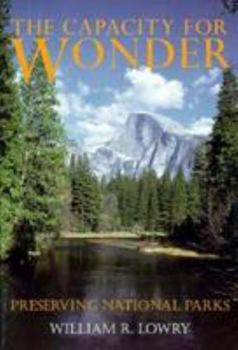
The Capacity for Wonder: Preserving National Parks


Select Format
Select Condition 
Book Overview
The national parks of North America are great public treasures, visited by 300 million people each year. Set aside to be kept in relatively natural condition, these remarkable places of forests,... This description may be from another edition of this product.
Format:Paperback
Language:English
ISBN:0815752970
ISBN13:9780815752974
Release Date:August 1995
Publisher:Brookings Institution Press
Length:380 Pages
Weight:0.95 lbs.
Dimensions:0.8" x 6.0" x 8.9"
Customer Reviews
2 ratings
Good comparative study of US and Canadian national parks
Published by Thriftbooks.com User , 18 years ago
This book examines national parks in the United States and Canada, two neighboring countries with extensive park systems. Clearly each of these countries can learn from the other's experience, and Lowry's book is an excellent introduction to the similarities and differences in the two park systems. He also provides extensive discussion of a sampling of parks in each country, some well-known and others not well-known at all. Lowry's central theoretical framework examines political support for the parks and the degree of consensus on the goals for parks. He treats these as if they were exogenous, independent variables. However, clearly the political economy of each country affects these goals. A pro-development agency such as the Army Corps of Engineers enjoys political consensus because it operates in a pro-development political system. It's hard to know how you could change the Corps (or many other agencies) without changing the political system as a whole. The research and most of his writing reflects the Reagan and G. H. W. Bush administrations, which were hostile to the environment. Thus, his book casts US politics as generally "bad," while Canadian policies are generally "good." However - - as he realizes - - the history of the two park systems is very different, and for most of the twentieth century he would have classified Parks Canada as having worse policy than the US National Park Service. To better understand the two countries, Lowry should distinguish more clearly between the legislative and executive factors affecting the parks. As Lowry acknowledges, Clinton's Interior Secretary Bruce Babbitt had very different priorities than the Reagan and Bush administrations, yet the system of congressional pork remained unchanged. Understanding park policy means separating out changes in executives from continuities in the legislature. Moving outside his framework of consensus and support to consider executive-legislative relations would be helpful. Looking more closely at executive-legislative relations would also enrich his comparison of the US and Canada. Obviously, Canada's parliamentary system works very differently than the presidential system in the United States. Ironically, Lowry does discuss the differences in federalism in the two countries, though in a global perspective there are more similarities than differences between US and Canadian federalism. Those objections aside, this is a notable book. The literature on national parks is dominated by historians, and it is welcome to have a different discipline's perspectives on the issues.
CHEERS Mr. Lowry! Yet, aren't we now in need of a sequel?
Published by Thriftbooks.com User , 28 years ago
I've lived in, worked for, and studied the U.S. National Park Service (NPS) and I can confirm that Lowry has done his homework well. This book is more than just a voice crying in wilderness. Lowry not only exposes the problems, he offers very viable solutions that merely need the political support of the common man to be implimented. Unfortunately, since this book's publication things have gotten worse, especially in Canada. One of my biggest frustrations has always been that the American public doesn't know the extent to which self-serving congressional interests are ruining our national treasures by preventing the NPS from doing its congressionally mandated mission of historic and natural preservation. It's not just budget cuts folks! As Lowry explains, its mega-cooperation owned concessions exploiting visitors at the expense of the very ecological health of parks in the name of "visitor services." It's scientific research intentionally poorly funded and results ignored, or worse yet, severely censored before they are allowed to be released to the general public. And it's all here, well documented in "The Capacity for Wonder" including scores of interviews with rangers from all over the continent who haven't given up... yet. This book is for all of us rangers who dare not speak because we have to feed our families, and for all you voters and tax payers who do "GIVE A DAMN!" but until now, just don't quite have enough accurate information to act.
Copyright © 2026 Thriftbooks.com Terms of Use
| Privacy Policy | Do Not
Sell/Share My Personal Information | Cookie Policy | Cookie Preferences | Accessibility Statement
ThriftBooks® and the ThriftBooks® logo are registered trademarks of Thrift Books Global, LLC
ThriftBooks® and the ThriftBooks® logo are registered trademarks of Thrift Books Global, LLC
