


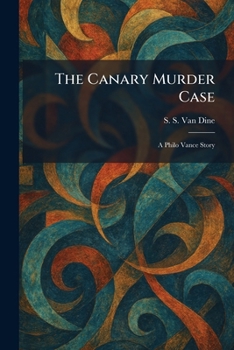
The Canary Murder Case: A Philo Vance Story

"The Canary Murder Case" is a cornerstone of Golden Age detective fiction, featuring the sophisticated and erudite amateur sleuth Philo Vance in one of his most challenging investigations. When the beautiful Broadway singer Margaret Odell, famously known as "the Canary," is found strangled in her locked apartment, the New York police are confronted with a crime that appears physically impossible. The case demands a mind capable of navigating both complex psychological motives and intricate physical evidence.
Philo Vance, with his vast knowledge of art, history, and human nature, steps in to assist District Attorney John F.X. Markham. Using his unique methods of character analysis and deductive reasoning, Vance peels back the layers of the victim's scandalous life and the various suspects drawn into her web. The narrative is celebrated for its intellectual rigor and its vivid depiction of 1920s New York society.
As one of the most famous entries in S. S. Van Dine's series, "The Canary Murder Case" set a new standard for the "whodunit" genre. It remains a compelling read for those who enjoy intricate puzzles, refined protagonists, and the classic atmosphere of early twentieth-century mystery fiction.
This work has been selected by scholars as being culturally important, and is part of the knowledge base of civilization as we know it. This work was reproduced from the original artifact, and remains as true to the original work as possible. Therefore, you may see the original copyright references, library stamps (as most of these works have been housed in our most important libraries around the world), and other notations in the work.
This work is in the public domain in the United States of America, and possibly other nations. Within the United States, you may freely copy and distribute this work, as no entity (individual or corporate) has a copyright on the body of the work.
As a reproduction of a historical artifact, this work may contain missing or blurred pages, poor pictures, errant marks, etc. Scholars believe, and we concur, that this work is important enough to be preserved, reproduced, and made generally available to the public. We appreciate your support of the preservation process, and thank you for being an important part of keeping this knowledge alive and relevant.
Customer Reviews
ThriftBooks ® and the ThriftBooks ® logo are registered trademarks of Thrift Books Global, LLC
