


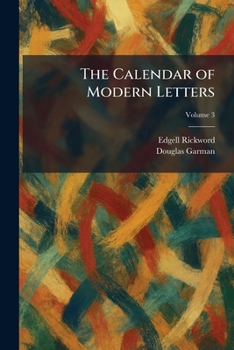
The Calendar of Modern Letters

'The Calendar of Modern Letters' stands as one of the most influential literary periodicals of the early twentieth century, serving as a critical touchstone for the development of English Modernism. Edited by Edgell Rickword and Douglas Garman, this third volume continues the publication's mission to scrutinize the literary landscape with rigorous intellectual honesty and creative vigor.
This collection features a diverse array of literary criticism, poetry, and short fiction, offering a window into the vibrant intellectual climate of 1927. The contributors challenge established Victorian standards, advocating instead for a more precise and analytical approach to contemporary writing. Within these pages, readers will find insightful essays that helped define the standards of modern literary theory, alongside creative works that exemplify the experimental spirit of the era.
As a vital record of literary history, Volume 3 of 'The Calendar of Modern Letters' remains an essential resource for scholars of English literature and those interested in the evolution of critical thought. Its commitment to evaluating literature on its own merits, rather than through the lens of moral or social utility, makes it a foundational text in the history of twentieth-century letters.
This work has been selected by scholars as being culturally important, and is part of the knowledge base of civilization as we know it. This work was reproduced from the original artifact, and remains as true to the original work as possible. Therefore, you may see the original copyright references, library stamps (as most of these works have been housed in our most important libraries around the world), and other notations in the work.
This work is in the public domain in the United States of America, and possibly other nations. Within the United States, you may freely copy and distribute this work, as no entity (individual or corporate) has a copyright on the body of the work.
As a reproduction of a historical artifact, this work may contain missing or blurred pages, poor pictures, errant marks, etc. Scholars believe, and we concur, that this work is important enough to be preserved, reproduced, and made generally available to the public. We appreciate your support of the preservation process, and thank you for being an important part of keeping this knowledge alive and relevant.
Customer Reviews
ThriftBooks ® and the ThriftBooks ® logo are registered trademarks of Thrift Books Global, LLC
