


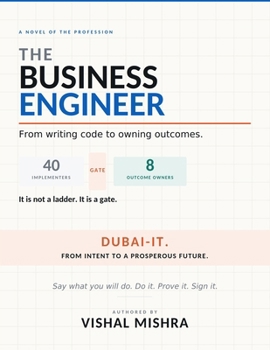
The Business Engineer: From Writing Code to Owning the Outcomes

Kabir Anand becomes an engineer because of a bridge. His father inspected railway bridges for thirty-one years and told him once: a train crosses because a man put his name on a number.
Kabir spends the next twenty years learning the opposite lesson. Pune, 2006, where a signed requirement document is scripture. A batch job that runs twice and debits four thousand customers. Bangalore, distributed systems, a growing reputation. Then Dubai, and eighteen months building the finest platform of his career, killed in a six-minute strategy review because nobody in the room, including him, had ever asked what the capability earned.
Then a Thursday afternoon in 2024. He hands an AI agent a brief he had estimated at six weeks. By five that evening the machine has written, unprompted, the six lines of code whose absence had cost him that night in 2008.
It has not taken my job. It has taken my alibi.
THE BUSINESS ENGINEER follows one engineer from Software 1.0 to Software 3.0, from writing code to owning outcomes, and eventually out of the building entirely into a company that sells cleared shipments instead of software. It is a novel, and it is a working manual.
Inside, illustrated with 46 original diagrams: The three-layer model: Intent and Assurance stay human, Orchestration is shared with machinesThe gate: why a capability needing 40 implementers needs 8 outcome owners, and what happens to the other 32The Authority Clause: the four rights that must be granted in writing, or the title is a liability transferWhy architecture is now a pricing decision, and what a twelvefold cost spread on one outcome looks likeImpostor syndrome as an evidence problem rather than a character problem, and the five moves that close the gapTwelve mental models and ten principles, extracted for reuseWhere the senior engineers of 2036 come from, a question this book refuses to pretend is solvedFor software engineers, staff and principal engineers, engineering managers, CTOs, CIOs, and product leaders who suspect the ground has moved and want a map drawn by someone who was standing on it.
Written in Dubai, the book takes its closing discipline from the city's own philosophy: say what you will do, do it, prove it, sign it.
A work of fiction. The narrator, his colleagues, and every company in these pages are invented. Financial figures are illustrative and labelled as such in the Author's Note.
Customer Reviews
ThriftBooks ® and the ThriftBooks ® logo are registered trademarks of Thrift Books Global, LLC
