


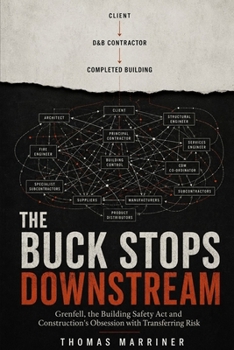
The Buck Stops Downstream: Grenfell, the Building Safety Act and Construction’s Obsession with Transferring Risk

Everybody wants someone else to own the risk.
Modern construction has become exceptionally good at allocating responsibility. Contracts, warranties, insurance policies and procurement structures can all determine who pays when something goes wrong.
But paying for a problem is not the same as preventing it.
The Buck Stops Downstream examines how responsibility moves through modern construction projects - from client to contractor, designer, specialist, supplier and insurer - and asks whether contractual risk transfer actually produces safer buildings.
Drawing on Grenfell, the Building Safety Act, major construction failures, legal cases and decades of industry reform, Thomas Marriner explores the gap between liability and genuine risk ownership.
At the heart of the book is a simple test: when a project says somebody owns a risk, do they also have the knowledge, control, resources and financial capacity to manage it?
From Design and Build and novation to value engineering, Building Control, competence, the Golden Thread and the post-Grenfell regulatory regime, the book examines why apparently rational commercial decisions can collectively produce dangerous outcomes - without requiring incompetent people or bad intentions.
Written from inside the construction industry, The Buck Stops Downstream is not a legal textbook or compliance manual. It is an examination of how buildings are actually procured, designed and delivered - and what must change if responsibility is to mean more than simply knowing who pays after something has gone wrong.
Because the real test of a safety culture is not what happens when safety is free. It is what happens when safety has a price.
Customer Reviews
ThriftBooks ® and the ThriftBooks ® logo are registered trademarks of Thrift Books Global, LLC
