


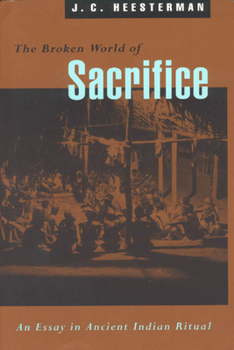
The Broken World of Sacrifice: An Essay in Ancient Indian Ritual

Select Format
Select Condition 
Book Overview
In this book, J. C. Heesterman attempts to understand the origins and nature of Vedic sacrifice-the complex compound of ritual practices that stood at the center of ancient Indian religion. Paying close attention to anomalous elements within both the Vedic ritual texts, the brahmanas, and the ritual manuals, the srautasutras, Heesterman reconstructs the ideal sacrifice as consisting of four moments: killing, destruction, feasting, and contest. He shows that Vedic sacrifice all but exclusively stressed the offering in the fire-the element of destruction-at the expense of the other elements. Notably, the contest was radically eliminated. At the same time sacrifice was withdrawn from society to become the sole concern of the individual sacrificer. The ritual turns in on the individual as "self-sacrificer" who realizes through the internalized knowledge of the ritual the immortal Self. At this point the sacrificial cult of the fire recedes behind doctrine of the atman's transcendence and unity with the cosmic principle, the brahman. Based on his intensive analysis Heesterman argues that Vedic sacrifice was primarily concerned with the broken world of the warrior and sacrificer. This world, already broken in itself by the violence of the sacrificial contest, was definitively broken up and replaced with the ritrualism of the single, unopposed sacrificer. However, the basic problem of sacrifice-the riddle of life and death-keeps breaking too surface in the form of incongruities, contradictions, tensions, and oppositions that have perplexed both the ancient ritual theorists and the modern scholar.
Format:Paperback
Language:English
ISBN:0226323013
ISBN13:9780226323015
Release Date:July 1993
Publisher:University of Chicago Press
Length:306 Pages
Weight:1.00 lbs.
Dimensions:0.7" x 6.1" x 9.0"
Customer Reviews
2 ratings
Brilliant Reconstruction of Transitions in Vedic Sacrificial Ritual
Published by Thriftbooks.com User , 17 years ago
Since nobody has put up a particularly accurate review of this wonderful book yet, I'll give it a try. The book centers on a scholarly reconstruction of the Vedic sacrificial ritual prior to its transition into the priestly, individualized, brahmanic form that is expressed in later Vedic texts. With superb analytical insight, the author takes the form in which Vedic sacrificial rituals have been recorded for later generations -- the various Vedic texts -- and proceeds to carefully reconstruct their sources in prior sacrificial ritual (itself a ritualized version of even more primordial communal strife), prior sacrificial ritual which, though originally contested between opposing parties, later became encapsulated and modified into solitary priestly activity. The genius of the project is that it takes many of the most peculiar aspects of Vedic sacrifice and shows, in painstaking detail, how they are modified vestiges of more primitive sacrificial ritual. Step by step, the book explores the historical movement away from an original ritual contest and communal meal involving various opposing social factions, and towards the radically altered "Vedic" version of the sacrificial ritual, with increasing metaphysical elements, internalized in the solitary brahman. The analysis makes sense out of texts on Indian sacrificial ritual by connecting them with transitions in Indian society more broadly, rather than taking the Vedic texts themselves as if they represented the true primal, original, ritual structure. Because of its "evolutionary" approach to ritual, this book is sure to annoy various dogmatists who have a vested interest in the ultimate importance of some more particular, and more internally consistent, interpretation of ancient Indian sacrificial ritual. But for those interested in approaching the heart of ancient Indian ritual from an academic perspective, who want to understand the Vedas as they actually are, this book is just about the finest source out there.
A most readable and enterprising study of sacrifice
Published by Thriftbooks.com User , 26 years ago
Heesterman's work on ancient Indian sacrifice is both revelatory and far reaching for any scholars interested in the quest for a general theory of ritual and sacrifice. The thrust of the essay is that sacrifice has three phases: killing, destruction and the communal meal. I have found his fundamental construct and commentary most revealing when applied to a range of sacrificial ritual from Patroklus' funeral in Homer's Iliad to headhunting among the Ilongot in the Phillipines, although he does give particular emphasis to the use of fire in sacrificial rites. The book is most readable, so the non-academic would find it most stimulating, however that does not mean its content is not dense. It is. All in all an absolutely brilliant text should be on the bookshelf of any serious mythologist, classicist, anthropologist, historian, etc. interested in ritual.
Copyright © 2026 Thriftbooks.com
Terms of Use | Privacy Policy | Do Not Sell/Share My Personal Information | Cookie Notice | Cookie Preferences | Accessibility Statement
ThriftBooks ® and the ThriftBooks ® logo are registered trademarks of Thrift Books Global, LLC
ThriftBooks ® and the ThriftBooks ® logo are registered trademarks of Thrift Books Global, LLC
