


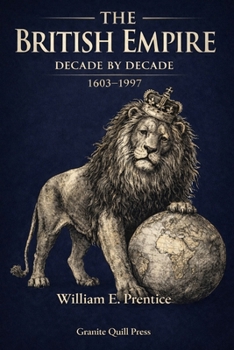
The British Empire: Decade By Decade 1603 - 1997

For more than three centuries, the British Empire shaped the modern world. From the union of the English and Scottish crowns in 1603 to the transfer of Hong Kong in 1997, imperial expansion, trade, conflict, governance, and decolonisation transformed continents and redefined global power.
This book tells that story decade by decade.
Rather than focusing on a handful of famous battles or imperial personalities, The British Empire: Decade by Decade, 1603-1997 traces the machinery of empire as it evolved: the charters and companies that launched overseas ventures; the naval power that secured trade routes; the plantation economies and industrial networks that generated wealth; the constitutional debates, rebellions, and reforms that reshaped authority; and the gradual dismantling of imperial rule in the twentieth century.
Across Europe, the Americas, Africa, Asia, and the Pacific, the empire was not a single moment of dominance but a long process of accumulation, adaptation, crisis, and retreat. Each decade brought new pressures and new opportunities, from commercial rivalry and global war to nationalist movements and economic realignment.
Measured in institutions as much as in armies, the British Empire was a system of governance and exchange that connected distant societies while producing deep inequalities and enduring legacies. Its influence can still be seen in borders, languages, legal systems, and political structures around the world.
This is a chronological study of power - how it was built, administered, contested, and ultimately relinquished - and how a maritime kingdom became, and ceased to be, a global empire.
Customer Reviews
ThriftBooks® and the ThriftBooks® logo are registered trademarks of Thrift Books Global, LLC
