


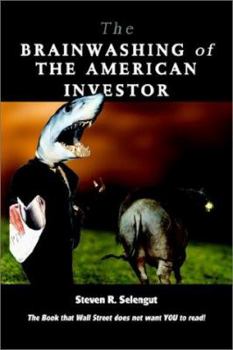
The Brainwashing of the American Investor: The Book That Wall Street Does Not Want You to Read!

Select Format
Select Condition 
Book Overview
Get Inside Wall Street! A scathing expose' of still unpublicized conflicts of interest that cheat investors. Plus a four step approach to successful investment management. This description may be from another edition of this product.
Format:Paperback
Language:English
ISBN:1403306206
ISBN13:9781403306203
Release Date:January 2002
Publisher:Authorhouse
Length:268 Pages
Weight:0.89 lbs.
Dimensions:9.3" x 0.5" x 6.3"
Customer Reviews
5 ratings
The Best Investment Book I Have Ever Read
Published by Thriftbooks.com User , 18 years ago
As I write this (11-27-2007), the markets are getting ready to open after closing down the previous day. The Dow Jones industrial average has fallen nearly 240 points and the headline in the local paper is screaming "Wall Street suffers another big hit." Serious-faced announcers on cable-TV are saying the Dow is down 10.03 percent from its mid-October closing high, officially putting the blue chip index past the 10 percent threshold that signifies a correction. For Steven R. Selengut, author of The Brainwashing of the American Investor, corrections such as this are as welcome as rallies. The market, he points out, is just doing what the market has always done. "Here is some advice that you just won't hear on CNBC or read in The Journal," he writes in this revised edition of an earlier book bearing the same name. "It is based on one incredibly simple market fact: There has never been a market correction that has not succumbed to yet another rally. So when the doom and gloom noise becomes deafening, get yourself out there and party." When the markets move into a correction, Selengut's investment strategy already has investors sitting on a pile of cash -- accumulated profits taken on stocks as the market rallied -- plus cash thrown off from fixed-income securities. As the NYSE-traded stocks he follows move down 20 percent or more, he moves back into them and waits for a 10 percent profit to cash out and then look for another opportunity to repeat the process. Even better, for skittish investors such as me, Selengut's unique "Working Capital Model" reduces the emotional factor by taking the emphasis off market value and focusing on growth of working capital, defined as the total cost basis of the securities and cash in the portfolio. As long as working capital is increasing, market value is irrelevant. As a recent retiree, I appreciate this conservative approach to growing working capital. I implemented and followed the trading strategy myself for about a year and a half before turning my account over to Sanco Services, an investment management company founded and operated by Selengut. The Working Capital Model worked the way it was presented. My only reason for turning the account over to Sanco was to be sure that my financial assets would be handled in such a way that my wife would not have to worry about an adequate income in the event that I was no longer able to manage the assets myself. The Brainwashing of the American Investor is a book I wish I had been able to read 30 years ago. Those of you who still have years of investing ahead of you would do well to buy this book and read it thoroughly two or three times. It will save you a lifetime of mistakes that come from following conventional wisdom. This is the book that Wall Street does not want you to read.
Unique Advice That Stands Out From The Crowd
Published by Thriftbooks.com User , 22 years ago
I've spent well over $... on my investment library. So many of the books blend together with little worth remembering let alone implementing, but this is one of two that stands out. Besides being written in an entertaining and irreverant style (if you're an accountant, attorney, or Wall Streeter, look out!), it has immensely practical advice.Steve is one of 2 authors I've read that focuses on making money on the market's inherent volatility vs. trying to guess what's next. Unlike Technicians who play volatility AND try to guess what's next, Steve just assumes that it (volatility) will be there, like the waves on the ocean (interesting that he has a beach house!). Using safe stocks, he buys lower and sells higher, no greed, just take what the market is going to give you. Saves a lot of time and appears to work. It would be nice to see some historical results documented in the book, but his site does provide some numbers to evaluate.The other author... Robert Lichello, recently deceased. Zany book, but accurate. Steve adds the missing ingredient - safety.
An enlightened self managed investor
Published by Thriftbooks.com User , 22 years ago
As an individual investor who has manged my own investments for over 40 years, I found The Brainwashing of the American Investor to be a terrific guideline for the future. Not only did I identify many many mistakes that I made thru the years, but the logical approach outlined by Steven Selengut has to make sense to anybody who has tried to get meaningfull portoflio guidelines (from Wall Street brokers, advisors, etc) for future investments tailored to individual needs. After 3 years of going downhill the buy and hold approach for stocks, bonds and mutual funds is dead. Great Book!!!!!
TELLING IT LIKE IT IS
Published by Thriftbooks.com User , 23 years ago
What an eye opener! At last a book about investing that tells it how it is. Those who read "THE BRAINWASHING of THE AMERICAN INVESTOR" will be a lot harder to fool. Selengut helps investors learn to "watch" the lemmings and not follow them to financial ruin. Wall Street loves to convert investor funds to their own bottom line. Here the author tells it like it is and shows how to avoid being "BRAINWASHED" and "HOW TO" plan to successful investing. Way to go!
Profit like a trader. Sleep like an investor.
Published by Thriftbooks.com User , 23 years ago
This book is an expanded version of the author's first book, originally titled _A Millionaire's Secret Investment Strategy_.This book is part exposé (about 30%) and part technique (70%).It explains how the author made his million (in real dollars, not in market value) actually investing (not writing about investing, not by commissions, and not by salary from a mutual fund company). That background separates the author from about 99% of all other authors who write about the stock market.It's defintely an eye-opener book. The technique or strategy presented is almost a "why didn't I think of that?" kind of strategy. Basically, the idea is to run your portfolio the same way you would run a business. It's not a get-rich-quick kind of plan, but because stock market investing is a compounding activity (the more you make the more you can invest), you can grow geometrically instead of linearly. The other nice feature of this strategy is that it requires a minimal amount of analysis compared to many others that I've seen. You just focus on the essential measures of quality (and they are essential).Be warned though: every business has it's good and bad times. Sometimes your portfolio will very profitable, but other times the profits may be slow in coming. It's the nature of almost all businesses. The key is to maintain your plan during the slow times and reign in your greed during the boom times.
Copyright © 2025 Thriftbooks.com
Terms of Use | Privacy Policy | Do Not Sell/Share My Personal Information | Cookie Policy | Cookie Preferences | Accessibility Statement
ThriftBooks ® and the ThriftBooks ® logo are registered trademarks of Thrift Books Global, LLC
ThriftBooks ® and the ThriftBooks ® logo are registered trademarks of Thrift Books Global, LLC
